01 June, 2011

01 June, 1944

438th AAA AW BN
APO 654 % Postmaster, N.Y.
England
1 June, 1944        0740

Dearest sweetheart –

Another month started and I wonder what it will have in store for us? I guess millions of other soldiers must be wondering the same thing. The spirit of expectation is terrific and one can just imagine how the Germans must feel.

I can hardly believe that it is really summer and that so much time has elapsed since we last saw each other. That’s the aggravating thing about time – it keeps moving along, but your mind is reluctant to keep moving with it. Anyway – this particular fine morning it is cloudy out, warm, with occasional light sprinkling. A sort of fresh healthy day – despite the fact that the sun is not out yet.

Last night we had an interesting evening for the first time in a long while. We had a fairly good show – “Phantom Lady” – i.e. it was comparatively new and interesting in its attempt to portray a psychiatric character. As far as it went – it was all right, but the dialogue didn’t quite tell as much as it could have, I thought. Following that (the picture was over at 2100) we had 4 Red Cross women entertain us. They had been present earlier as guests for dinner. One of them was Bessie Love – whom I’m certain you couldn’t remember; I did only by name. She was a star of the silent screen and just barely into the talkie era. She last played in something called the ‘Broadway Melody’. Your mother no doubt remembers her. She looked younger than she probably is and very demure. She was the Mistress of Ceremonies for the group – which sang, played the piano, accordion etc. – a typical Red Cross traveling group. The show didn’t break up until about 2230 and then we continued singing songs around the piano. It was 2330 when I got to bed – but the evening went by quickly.

There was no mail at all yesterday, darling, and it seems to me I have several letters due me now – Got to leave now for a B.C. meeting at 0800 – will continue later, dear – So long for now –

1130

Hello again – dear –

Back again and waiting for lunch now. Meeting consisted of the usual – passes, administrative details etc.

I got quite a kick out of the note that Granny B. included in your letter of the other day. It was sweet of her to take the trouble – and I’ll write her again one of these days. And I’m glad you liked the snaps, darling. The fact that I look well has nothing to do with my being away from you, sweetheart! It is due merely to the fact that I’m getting plenty of fresh air, good food and rest. The pipe, dear, is not the one I had in my car; if I remember correctly – that is still at home. As for the castle looking neglected – it is, but not as much as appears. Remember it’s an old stone affair and that can get to look shabby. But 400 yrs is a long time. It’s nice inside though, and you are right – gigantic is the word for it.

Well – sweetheart – it’s time to close now. I sure wish I could be with you one of these nights to show you a little plain and fancy loving – but I’ll postpone that. Meanwhile, I love you dear and want you more for my own with each passing day. Love to the folks – and


All my love to you
Greg

* TIDBIT *

about Bessie Love


Bessie Love was born Juanita Horton in Midland, Texas on 10 September, 1898. In the 8th grade, she moved to Hollywood where her father was a chiropractor. After graduation from Los Angeles High School and traveling around the country for six months, her mother sent her to Biograph Studios to earn enough to help the family's finances. There she met D.W. Griffith, a pioneering silent film director, who gave her the screen name "Bessie Love."  Her first role was small, in Birth of a Nation (1915), but her roles increased in importance as she was in eight movies in the next eight years. As her roles grew, so did her popularity. Love was able to successfully transition to "talkies", and in 1929 she was nominated for the Academy Award for Best Actress for The Broadway Melody.

However, by 1932 her American film career was in decline. She moved to England in 1935 and did stage work and occasional films there. As war came in Europe she returned to the US for a while, worked for the Red Cross, and entertained the troops. After the war she moved back to Britain where she kept her main residence, and continued to play small film roles for film companies in both the US and Britain. As late as 1971 she played a small but pivotal role as a switchboard operator in Sunday Bloody Sunday. Her career came to a quick halt soon after that however, and she moved permanently to the United Kingdom, becoming a British citizen. She made a comeback in the 1980s with roles in Ragtime (1981), Warren Beatty's Reds (1981), Lady Chatterley's Lover (1981) and (her final film) The Hunger (1983), starring Catherine Deneuve, David Bowie, and Susan Sarandon. In all, Love featured in 131 films and TV episodes.

Love was married once, from 1929 to 1935, to film producer William Hawks, and she had a daughter from that marriage. She died in London, England from natural causes on April 26, 1986.

Here is a short clip from a number performed in 1929, followed by a slideshow memorializing Bessie Love:


31 May, 2011

31 May, 1944

438th AAA AW BN
APO 654 % Postmaster, N.Y.
England
31 May, 1944        0720

Dearest darling Wilma –

Although we had a pretty good thunderstorm yesterday p.m. – the heat wave – if you can call it that – is still with us. The highest it has been here is somewhere in the low or middle 80’s, but it rarely gets that hot here, and if it does, it doesn’t last long. We have the same humidity here that Boston has, with the complete lassitude etc. that goes with it. Yesterday – it was really quite annoying – but fortunately, I didn’t have too much to do, dear.

I got no mail yesterday, but having heard from you the day before, I really didn’t expect any.

Say – in reading about Mr. Clark’s home – I find you really enthused, darling. And to top it off you say you’d really adore a place like that. Now if you’re going to get ideas like that this early in life, maybe you’d better not go out there quite so often? It does sound nice, though, dear – and I’m glad you’re enjoying your trips out there.

You mention Rosalyn (do I know her?) graduating Holyoke and that she called and wondered how you kept from being bored. I sometimes have wondered about that too, darling. You never mention that you are, for which I’m grateful – because I hate to think of you getting tired of ‘hanging around’, dear – although sometimes it must seem just like that, I’m sure. As for you and me in the days when we first went out, sweetheart, – I, too, liked to be alone with you rather than with anyone else; you knew that. And I’d have stayed out all hours of the night, if I thought we could get away with it. I knew how your mother felt about late hours – so “why antagonize her?” I thought. After all, darling, I was trying to make a good impression. But don’t try to make me believe that I immediately opened the door of my car, dear!! Seems to me – there was usually a slight delay – you must remember. And, dearest, you shouldn’t feel surprised at the things you admit to me – for after all, if not to me, then to whom?

Today being the end of the month – means a little extra running around. In the days when we were in Camp, it was a simple thing getting the men’s pay. It’s different here; you have to hit the right finance office – in the right city – i.e. right for your outfit. Anyway – at 1030 this a.m. – the B.C.’s and I have to go to a nearby town and get the pounds, shillings and pence for the boys’ mild and bitters. And how they go through it, too!

I’ll have to stop now, sweetheart, and get going down to the dispensary. My thoughts are always with you, dear, day and night – and all I do is dream of the days when I’ll finally be with you. Remember darling that I’m very much in love with you and miss you terribly –

Love to the folks – and

All my love to you
Greg

30 May, 2011

30 May, 1944

438th AAA AW BN
APO 654 % Postmaster, N.Y.
England
30 May, 1944       0725

Dearest Sweetheart –

I just realized – in writing the date – that today was or at least used to be, a nice holiday back home. Last year – I arrived at Camp Edwards on May 29th from S. Carolina after being away for 6 months – and it sure was a thrill. I don’t know just how I would act if I were home again now – but I have a pretty good idea.

As a matter of fact the English have their holiday, too, at the end of May – but it’s not like our Memorial day. It marks the end of the whole Easter period – sort of the other end of the line from the beginning of Lent – with Easter in the middle. The Holiday is called Whitsuntide and as most holidays are celebrated – it includes Saturday, Sunday and Monday. Of course it made no difference to us.

Say that news about Betty and Les getting married on a 3 day pass was surprising. I didn’t think their folks would approve. Of course I don’t know what sort of outfit he’s with. If he thinks he’s in a semi-permanent set-up, I do believe he ought to get married; but if he’s with an infantry division – he’s bound to move out – and soon. In that case – I think he ought to wait it out, if he’s waited so long. But that’s their problem and not ours. Incidentally – I assume Betty is still at school and due to graduate soon – is that correct?

There seems to have been a delay in mail in your direction, too, dear, for which I’m sorry. It’s worse when you don’t hear from us – but remember – I’ve told you 2 or 3 times now – to expect a delay and the one you’ve already had – is not what I have in mind. You finally got the letter in which I mention Charlie and you say I sounded upset. I was – in a way – because the whole thing was rather nasty and I had to help cover up and pretend that nothing had happened. Yes – I’m on speaking terms with him – there was no trouble between the two of us at all. I suppose I might as well tell you just what the trouble was – so you’ll understand. It all hinged on Charlie’s attention to men – especially enlisted men. It had been going on for some time – I mean – over a year anyway – and the Colonel knew about it, I did – and perhaps 3 other officers. Well – on the week-end I wrote you about it – an incident blew everything wide open and he was transferred out of here in less time than it takes to write it. He is now awaiting a trip back to the States – where I believe he will be asked to resign his commission. Incidentally, dear, I’ve written to no one about this – except you. So now you know. We’ve had no replacement yet – but at least there’s no tension here now.

Sweetheart, I haven’t told you I loved you yet – this morning – and here I’m almost ready to leave – so I love you!! I hope you’re getting mail more regularly now, dear – but anyway, I’m writing every time I can. Remember that when you don’t hear regularly. So long for now, dear – love to the folks and

All my love is yours
Greg

* TIDBIT *

about Whitsuntide

CLICK ON PICTURE TO ENLARGE

Goosnargh, UK, 1893
Whit Walkers Enjoy their Picnic Tea

Whitsunday (Whit Sunday) is celebrated seven weeks (50 days) after Easter Sunday. Whit Sunday is a favourite day for baptism. It is thought that because people are often baptized dressed in white, Whit Sunday was probably originally known as "White Sunday." It is also known as Pentecost, meaning "the fiftieth day". This day is historically and symbolically related to the Jewish harvest festival of Shavuot, which commemorates God giving the Ten Commandments at Mount Sinai fifty days after the Exodus. Among Christians, Pentecost commemorates the descent of the Holy Spirit upon the Apostles and other followers of Jesus. The Pentecostal movement of Christianity derives its name from this biblical event.

The week following Whit Sunday is known as "Whitsuntide" or "Whit week". "Whit Monday" is a public holiday in many European countries including Austria, Belgium, Cyprus, Denmark, Estonia, France, Germany, Hungary, Iceland, Luxembourg, the Netherlands, Norway, Portugal, Romania, and (most parts of) Switzerland. In Sweden it was also a public holiday, but Pentecost Monday (Annandag Pingst), through a government decision December 15, 2004, was abolished and replaced with the Swedish National Day on June 6th each year. In Italy and Malta, it is no longer a public holiday. It was a public holiday in Ireland until 1973. It was a bank holiday in the United Kingdom until 1967.

In the UK, the adoption of a Late Spring Bank Holiday on the last Monday in May is an attempt to deal with the fact that Whitsuntide is a moveable feast dependent on the date of Easter. Although it is no longer necessarily at the church's Whitsuntide, the general public still refers to this holiday as "Whit Monday." Two main traditions persist, particularly in the North of England - "Whit Walks" and "Whitsun Ales."

Whit Walks are now confined almost exclusively to the industrial towns of northern England although they were once much more widespread. The whole community assembles at a central point - usually a school or church - and parades around the town or village. The parades will be led by a brass band with the clergy and local dignitaries, followed by the uniformed organizations - Scouts and Guides, Boy's Brigade etc., and finally local families all in their best new clothes with the girls dressed in white, Whitsun being a corruption of White Sunday. The Whit Walkers will very likely make their way to the local green or playing field and there the "Whitsun Ale" will begin.

A "Whitsun Ale" is, despite its name, not a type of beer! Whitsun Ales are country fairs, with sports and competitions, music and of course socializing, eating and drinking, in fact a major event on the social calendar. After the Civil War (English, not American) the Puritan government banned all types of merrymaking. But after the Restoration of Charles II, Whitsun Ales became a major event - helped no doubt by the fact that Charles was born on a Whit Monday and so encouraged the celebration. The Ales are often sponsored by a pub or brewery, giving rise to the misconception that the event is named for the beer.

Another custom on Whitsunday involves cheese. In Gloucestershire, Whit Sunday is often referred to as 'Bread and Cheese Day' because of a very strange custom that takes place on this day. In St Braivels, Gloucestershire, following evensong on Whit Monday, basketfuls of bread and cheese are thrown from a wall near the old castle, to be scrambled for in a lane below. The locals of St Braivels have been hurling bread and cheese since the 13th century, when the custom began probably as a payment for the villagers' right to cut timber from a nearby wood. In Randwick, Gloucestershire, after rolling three double Gloucester cheeses around the church, one is cut up and shared amongst bystanders and the other two are rolled down a steep hill. In Stilton, Cambridgeshire, teams of four, in bizarre costumes, roll stilton cheese along a 50-yard course. They must not kick or throw the cheeses. The prize is a whole Stilton Cheese, which weighs about 16 pounds, and bottles of port — the traditional accompaniment.

Cheese rolling also takes place in other areas around England. The most outrageous event takes place in Brockworth, Gloucestershire down Cooper's Hill and is known for commonly causing injuries to those taking part, with sprains and broken bones common. In 2009, the injury toll of 18 was described as 'low' by St John Ambulance. Ten of the wounded were spectators. Six people fainted just watching the event and four other spectators suffered minor injuries. One of those had fallen out of a tree and was taken slowly down the 100ft slope on a spinal board. Three cheese-chasers were taken to hospital for treatment - two with suspected spinal injuries and one with a dislocated shoulder. The rest had cuts and bruises. The even is no longer officially sponsored. The number of competitors has mushroomed and now people come from all over the world to chase rolling cheeses in this event which is thought to go back 600 years. From Urban Pictures, UK comes this video about the 2022 event.

29 May, 2011

29 May, 1944

438th AAA AW BN
APO 654 % Postmaster, N.Y.
England
29 May, 1944        0715

My dearest darling –

The start of another week with lots of things to take care of. But one thing about being busy – the days do go by very quickly, and I like that, dear. This past week-end was gorgeous from point of view of weather – although we couldn’t partake of it too much. However – for a couple of hours – Sunday afternoon we were able to play a game of soft-ball, officers v. enlisted men (we lost 17-5!). The sun was actually very hot and I ended up with a swell burn.

Sweetheart, before I forget it, Father’s day is fast approaching and I’ve done nothing about it. I haven’t got the slightest idea about presents from way back here, but you ought to be able to figure something out. I’m enclosing a check, dear, which ought to cover a Father’s Day gift for both our dads. Send them from both of us – if you wish, but at any rate – will you take care of getting a couple of gifts and seeing that they are delivered on the appropriate day? I wouldn’t ask you to do it, darling, but you invited me some time ago. Incidentally – if you see something you’d like to get that the check won’t cover – get it – and let me know the difference.

I was interested in your statements about Stanley Berns, how he looked and how he felt about going back. I guess the Pacific assignment is no sinecure – and from what I’ve gathered from others who have been there – they’re never anxious to return. I’m sure glad they didn’t send us in that direction; it could very well have been, too, because others went there at the same time that we were coming over here.

Darling, don’t you forget for a moment that I realize how much you’re doing to help my folks forget I’m away. You shouldn’t have any doubts about that at all. I think if I hadn’t met you and become engaged to you – they’d have taken my being away very much harder than they do now. And especially are they happy in the thought that when I come home, I’ll marry you. They’ve always wanted to see me married – and I think they see now why I waited so long. Put it all together, sweetheart, you have made them very happy and given them a new interest – at a time when they needed it most – and I want you to realize that I know that and appreciate it.

Well, my pet, I’ve got to go to work again – and try to earn my pay. I hope all is well with you at home – and the family – and send my love to the folks. I love you and miss you, dearest, and if I don’t tell you that often enough – it isn’t because I’m not thinking it and feeling it.

For now, all my love, darling
Greg.


* TIDBIT *

about Stanley Berns

Mr. Berns was born in Roxbury and moved to Brookline in 1920. He was educated in Brookline and graduated from the University of Pennsylvania in 1939.After Pearl Harbor he enlisted in the Navy was assigned to Officer Candidate School at Columbia University, where he was commissioned an ensign in 1942.

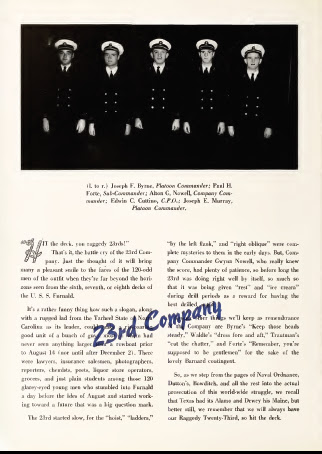
Here are four pages from Side Boy, the book published for the graduating class of Midshipman in which Stanley was trained. The first two are the title page and an excerpt from Franklin Delano Roosevelt's Navy Day speech from October 27, 1941. The last two are about the 23rd Company in which he was trained.

CLICK ON IMAGES TO ENLARGE


Stanley served as communications officer aboard the USS Griswold between 1942 and 1945 and saw action in the Solomon Islands, Guadalcanal and the Pacific theater. The Griswold (DE-7) was launched 28 April 1943 at the Boston Navy Yard. After shakedown in Bermuda, Griswold headed for the Pacific. Immediately pressed into service, she escorted convoys through the South Pacific. On 12 September, 1944 she conducted a 4-hour attack on a Japanese submarine off Guadalcanal but was not credited with a "kill." At 2200 on the night of 23 December, 1944, patrolling off Lunga Point, Guadalcanal, she was dispatched to investigate a periscope sighting. Alert sonar operators picked up the contact immediately, and held it for the next 5 hours as the determined DE conducted attack after attack on the elusive Japanese raider. Oil slicks and air bubbles after the sixth and seventh attacks told Griswold that her quarry was hit—this was confirmed shortly before 0300 on 24 December when a periscope poked out of the water. Griswold charged in for her eighth attack, laying a lethal pattern of twelve depth charges. A heavy oil slick dotted with debris rose to the surface, and the tenacious ship and crew were credited with sinking I-39.

CLICK ON IMAGES TO ENLARGE

U.S.S. Griswold

After overhaul at Mare Island, the escort ship returned to the Pacific theater on 3 June 1944 to escort convoys and participate in training exercises out of Pearl Harbor well into 1945. Reaching Okinawa on 27 May 1945, Griswold was shortly rewarded with two kamikaze kills, 31 May and 5 June. The second of those would-be kamikazes dived on Griswold; but she evaded him and the marauder exploded into the ocean so close that fragments of the Japanese plane showered over her. That same day two other American ships were seriously damaged by kamikazes as Japan made her desperate, and futile, effort to reverse the tide of war. At war's end she sailed triumphantly into Japanese waters, anchoring in Tokyo Bay on 10 September, 1945. Embarking passengers for stateside, Griswold cleared Tokyo 6 days later and arrived in San Pedro, California on 8 October, 1945.

After the war Stanley returned to Boston. He and his brother co-founded Pullman Vacuum Cleaner Corp., which went on to become the world's largest manufacturer of commercial vacuum cleaners. In 1960 he developed an interest in horticulture and bought a 76-acre parcel in Sandwich, Massachusetts known as the Dexter Estate. He rehabilitated the grounds and grew and sold rhododendrons and azaleas throughout the East Coast. Later, he sold the estate to the Lilly Foundation and it became Heritage Plantation, now named Heritage Museums and Gardens.

Stanley Berns died on July 28, 2005, leaving two sons, a daughter, seven grandchildren and three great-grandchildren as well as a brother and a sister.

28 May, 2011

28 May, 1944

V-MAIL

438th AAA AW BN
APO 654 % Postmaster, N.Y.
England
28 May, 1944        1235

Dear sweetheart –

Just got back from a rather long bike ride – on business; there was no other transportation available and the matter had to be taken care of. It was warm and I’m pretty tired. We’ll be eating soon and then I think I’ll soak in a tub. Later there are more details to take care of and I’ll be busy. I’m writing this now because I may not be able to write later, dear.

Gosh these past couple of days have been like summer and it makes me recall with nostalgia the first days when we first went out together. I thought the Spring would be tough, darling, but I guess Summer, Fall and Winter – will all be the same. I shall not be truly happy until I am close to you once again – Love to the folks.
All my love
Greg.

27 May, 2011

27 May, 1944

438th AAA AW BN
APO 654 % Postmaster, N.Y.
England
27 May, 1944        0730

Dearest sweetheart –

Even at this hour – which is actually 0530, the sun is out bright and shining, and from the stillness of the air and the trees, it seems certain to be a hot day today. The natives say that even in this part of England – and I always think of Tennessee or the Western Part of New England – when I look around me – it really gets hot – except for about 4 or 5 days in the whole summer.

I got an old letter from you, yesterday, dear – from May 8 – but nonetheless welcome. I don’t know why it was delayed – but it must have gotten side-tracked one way or another. At any rate it was interesting – I mean your farming and your energy darling. I worked on a farm for a day once and I was sure it wasn’t for me. Incidentally, I never realized that Mr. Clark’s farm is where it is, or if I had been told, it didn’t stick. I found that very interesting too, very interesting. All you have to do is add an “E”.

And your story about the mailman was most amazing, sweetheart. That is what I’d call personalized service. We don’t get that in the Army, I can assure you. He certainly sounds most sympathetic and next time you see him, dear, thank him for me, will you? If he wants to come to the ceremony, it’s all right with me, too.

I also got a letter from a friend of mine in another AA outfit in Italy. He used to be with us long ago – our first time at Edwards – and he certainly has been through a lot of action.

Last night we were supposed to have a meeting, staff, at 1730 – in the Colonel’s room. That seemed unusual because we generally have them in his office. We were sure something big was going to pop. Well we went in and he was with another Colonel whom he introduced and said he had a few words to tell us. So we took out our notebooks and waited. This other Col. said “I won’t talk much”, and he didn’t. He opened a suitcase and brought out a bottle of Bourbon, and darling when that was gone, another bottle and another appeared. Well – they held the dinner bell off until 1830 and we were all feeling fine by then. The Col. was a classmate of our Col. and is AA liaison officer in London. It could very well be that our present set-up and fine location were a result of his direction – because the Army can work that way. He just felt like meeting the Staff and saying “Hello”.

Well, Sweetheart, it’s Dispensary time and I have to run along. I hope all is well at home, dear, and that you still love me and miss me the way I do you. If so – I’m happy, darling.

Love, for now, to the folks and

All my love to you for always
Greg

[Note from FourthChild: Mr. Clark’s farm was in Sherborn, Massachusetts, USA – hence "add an E” told Wilma where he was...]

26 May, 2011

26 May, 1944

438th AAA AW BN
APO 654 % Postmaster, N.Y.
England
26 May, 1944        0730

My dearest darling –

I rather like the idea of writing you so early in the day. It puts me in the right mood. I felt so good all day yesterday – I was certain it was due to that. Although I didn’t hear from you, dear, I did get a letter from my father – as I expected – telling me about the Sunday spent at your house; also as I expected, the folks had a grand time, enjoyed meeting more of the relatives and thought everyone was very friendly to them. But best of all, darling, was what my father had to say about you, namely – that you are the loveliest, sweetest girl a guy could possibly pick for a wife and that he insisted, as did my mother, that I’d hurry up and come home – so that I could marry you. You know, sweetheart, it’s so wonderful to be in love and realize that you’re a lucky fellow to have the girl you’ve always wanted – but what makes me feel particularly content is the fact that my folks love you as much as they do. And I know – and I’m sure you do too – that they are as sincere as two people could possibly be. If you don’t know it – you will. I’ve never known them to be otherwise – and that’s why I love to read my father’s letter and see how much they love you and want you to be one of their children. Incidentally – my dad writes that you tried on the house-coat – or whatever you call it – and that you looked lovely.

The enclosed negatives and prints are all I was able to get back. There are 5 of the negatives and only 4 pictures – for some reason or another, dear, but you can do what you want with them. My folks will probably want 1 or 2 – but you can take care of that I guess. It’s an awful chore getting pictures censored here – and this is the first roll I’ve had any luck with at all.

I’m glad that knocker arrived, dear. It’s really a rare one and an antique. The house from which is was removed has been standing for 200 years and is the present cite of our Dispensary. The rest of the stuff was junk – but I had to get it out of the way. Incidentally you mention that you’re anxious to see the prints. Have I referred to them in any other terms than print? What I mean is that if I just mentioned the word print – I wonder if you think I’m referring to some cloth. If I didn’t make myself clear – I meant etchings. I just don’t want you to be disappointed, darling, although I think you’ll like these anyway. And while I’m on the subject – Silverware is practically non-existent here and even in London. What they had was gobbled up by the 1st troops to arrive here. The same goes for china, too, although I wouldn’t have been interested in that anyway.

Well well – sweetheart – it’s time I should be on my way, so I’ll close now. Remember that I love you and only you, darling – and that goes for always.

Love to the folks –


All my love
Greg

The following photos were taken outside
Sherborne Castle, UK:


CLICK ON PICTURES TO ENLARGE

Greg on the back lawn


Greg on the left railing by front entrance


Greg in casual dress


Greg in Dress Uniform


Part of the 438th AAA AW BN Medical Detachment


Greg looking out his bedroom window