11 September, 2011

11 September 1944

No letter today. Just this:

Route of the Question Mark


[CLICK TO ENLARGE]

(A) Saint Gerard to (B) Romsée (55 miles)
7 to 11 September 1944

September 11... Romsee. It was near Liege, and the 90 mm's in the next field brought down a German plane the first night we were there. Capt ELLIS was injured in a fall from his motorcycle. We found a German warehouse and got ourselves a fine collection of blankets and mattresses. We had a shower near a coal mine, and one night we had ice cream.

* TIDBIT *

about Crossing the German Border

From The Siegfried Line Campaign written by Charles B. MacDonald for the U.S. Army's Center for Military History (1990) comes this:

The shadows were growing long as five men from the Second Platoon, Troop B, 85th Cavalry Reconnaissance Squadron, 5th U.S. Armored Division, V Corps, U.S. First Army, reached the west bank of the Our River. To cross and claim credit as the first patrol on German soil, their commander had told them, they would have to hurry. The men made only a hasty inspection before starting back. An hour later the report of their crossing was on the way up the chain of command. At 1805 on 11 September 1944, the report read, a patrol led by S. Sgt. Warner W. Holzinger crossed into Germany near the village of Stalzemburg, a few miles northeast of Vianden, Luxembourg.

Sergeant Holzinger's patrol preceded others only by a matter of hours. In early evening, a reinforced company of the 109th Infantry, 28th Division, crossed the Our on a bridge between Weiswampach, in the northern tip of Luxembourg, and the German village of Sevenig. Almost simultaneously, southeast of St. Vith, Belgium, a patrol from the 22nd Infantry, 4th Division, also crossed the Our near the village of Hemmeres. Men of this patrol spoke to civilians and, to provide proof of their crossing, procured a German cap, some currency, and a packet of soil.


On September 11, 1944, Colonel Lanham of the 22nd
(far left) tells General Barton (seated behind the wheel
of his jeep "Barton Buggy") of the crossing into Germany.

The crossing of the German border on 11 September was another strong draught contributing to a heady optimism with which Allied troops and their commanders were reeling. Operating along the Channel coast, the Canadians already had captured Dieppe and the 1st British Corps of the First Canadian Army was putting the finishing touches to the conquest of Le Havre. The Second British Army had overrun Brussels and Antwerp, the latter with its deepwater port facilities almost intact. The First Army had taken Liège and the city of Luxembourg. The Third Army in northeastern France was building up along the Moselle River and already had a bridgehead near the Lorraine city of Metz. Having successfully landed in southern France on 15 August, the two armies in the south soon would become part of a single western front. During 11 September a patrol from the Third Army made contact with French units from the south near Dijon.

Most of the fighting immediately preceding the crossing of the German border had been pursuit warfare. The Germans were on the run. Except for the Third Army, which had been handicapped for five days while bearing the brunt of a general transportation shortage and gasoline drought, the Allied drive had reached its zenith during the, period 1-11 September. During these eleven days the British had traveled approximately 250 miles, from the Seine River to the Belgian-Dutch border. The First U.S. Army had taken time out near Mons, Belgium, to bag about 25,000 Germans in a giant pocket and make an abrupt change in direction. Still, they had covered approximately 200 miles. By 11 September the Allies had reached a general line which pre-D-Day planners had expected would be gained about D Plus 330 (2 May 1945). The advance thus was far ahead of schedule, some 233 days.

A most encouraging feature of Allied success was that casualties had been lighter than expected. Exclusive of the forces in southern France, Allied casualties from 6 June to 11 September were 39,961 killed, 164,466 wounded, and 20,142 missing, a total of 224,569, or a little more than 10 percent of the total strength committed. Since the landings in Normandy, the Germans had lost approximately 300,000 men, while another 200,000 were penned in various redoubts.

Despite an acute shortage of ports, Allied build-up in men and matériel had been swift. By the afternoon of 11 September a cumulative total of 2,168,307 men and 460,745 vehicles had landed in Normandy. General Eisenhower, who had assumed direct operational command in the field on 1 September, controlled on the Continent 26 infantry divisions (including 1 airborne division) and 13 armored divisions (not including a number of cavalry groups and separate tank battalions). Of this total the British and Canadians had furnished 16 divisions (including 1 Polish armored division), while the Americans had provided 23 (including 1 French armored division).

As soon as General Eisenhower assumed direct command of the forces in southern France, he would gain 3 American infantry divisions (not including an airborne task force of approximately divisional size), 5 French infantry divisions, and 2 French armored divisions. The total for the Western Front would then be 35 infantry and 14 armored divisions. In addition, 2 U.S. and 2 British airborne divisions, 1 Polish airborne brigade, and a British air portable infantry division were in Supreme Headquarters reserve.

General Eisenhower's 49 divisions were opposed, theoretically, by about 48 infantry and 15 panzer-type divisions, plus several panzer brigades. As noted by Generalfeldmarschall Gerd von Rundstedt, who on 5 September began a second tour as Oberbefehlshaber West (Commander in Chief West), these forces actually existed only on paper. While Allied units were close to full strength, hardly a German division was. Most had incurred severe losses in both men and equipment, and many were badly demoralized from constant defeat in the field. The equivalent of five divisions had been corralled in the Channel Islands and the coastal "fortresses." Rundstedt estimated that his forces were equivalent to about half the number of Allied divisions. Allied superiority in guns was at least 2½ to 1 and in tanks approximately 20 to 1.

The disparity between forces was less striking on the ground than in the air. Operating from bases in the United Kingdom and France were 5,059 American bombers, 3,728 American fighters, 5,104 combat aircraft of the Royal Air Force, and additional hundreds of miscellaneous types for reconnaissance, liaison, and transport. The enemy's one tactical air force in the West, the Third Air Force (Luftflotte 3), had only 573 serviceable aircraft of all types. In the entire Luftwaffe the Germans had only 4,507 serviceable planes, and most of these had to be retained within Germany to contest Allied strategic bombers.

Allied strategy, as expressed in pre-D-Day planning at Supreme Headquarters, Allied Expeditionary Force (SHAEF), looked toward the ultimate objective of Berlin; but on the way the Allies wanted an economic objective, which, if captured, "would rapidly starve Germany of the means to continue the war." This was the Ruhr industrial area, the loss of which, together with Belgium and Holland, would deprive Germany of 65 percent of its production of crude steel and 56 percent of its coal. The widespread deployment of the Allied armies on 11 September reflected General Eisenhower's pre-D-Day decision to go after the Ruhr and Berlin on a broad front. Later to become known as the "broad front policy," this concept was not appreciably different from the time-tested military strategy of multiple parallel columns.

The true German situation was perhaps most aptly described by one of the few voices of caution raised on the Allied side during the halcyon days of pursuit. On 28 August the Third Army G-2 had put it this way:

Despite the crippling factors of shattered communications, disorganization and tremendous losses in personnel and equipment, the enemy nevertheless has been able to maintain a sufficiently cohesive front to exercise an overall control of his tactical situation. His withdrawal, though continuing, has not been a rout or mass collapse. Numerous new identifications in contact in recent days have demonstrated clearly that, despite the enormous difficulties under which he is operating, the enemy is still capable of bringing new elements into the battle area and transferring some from other fronts ....

It is clear from all indications that the fixed determination of the Nazis is to wage a last-ditch struggle in the field at all costs. It must be constantly kept in mind that fundamentally the enemy is playing for time. Weather will soon be one of his most potent Allies as well as terrain, as we move east to narrowing corridors ....

10 September, 2011

10 September 1944

438th AAA AW BN
APO 230 % Postmaster, N.Y.
Belgium
10 September, 1944       1145
Dearest sweetheart –

It’s almost noon now – but I’ll get this started anyway because I expect to be kind of busy after lunch. We’ll probably be leaving this place tomorrow and we’ll all miss it because it certainly was a comfortable and luxurious spot.

We haven’t had any mail for a few days and because of the situation at the moment – I don’t think much of our mail has gone out recently. That means that you’ll probably be getting a bunch of these letters at one time, dear, so bear with me. (See you later)

Later… Yesterday I took the opportunity of taking a little trip to a city not too far away. I looked around for things to buy – but these cities have really been cleaned and you may think things are expensive in the States, but you should see the prices here. We – another officer and I went into a ladies’ store – or should I say a women’s apparel store? Anyway the price for a handkerchief, not laced or anything like that – came to three dollars, and these flimsy blouses that girls wear – sold for the equivalent of $25.00. The Prince – by the way – told us to beware of things made of cloth – that we might want to buy here because most of the articles are Ersetz and dissolve in warm water.

Well we shopped around some more and I finally found what I wanted. I was looking for a Birthday Gift for you dear, and was beginning to think I’d just have to write you later and then tell you you’d have to wait until I get back. I’m not going to tell you what it is, darling – Naturally! It’s not much – but I just want you to know that I’m thinking of you – and how much I’d like to be with you on your Birthday. I just got cheated on that last year; we were crossing the Atlantic that day – and I was sure lonesome. Lonesomeness somehow doesn’t sum up my feelings now – sweetheart. It’s more than that – it’s a deep longing to be with you in reality and for always. Anyway – the only hint I’ll give you dear is that what I got for you is probably difficult to obtain in the States these days – because it’s difficult even over here – and – No! it is not a bottle of Scotch.

Greg probably took a break from shopping to stop at this cafe.

CLICK ON IMAGES TO ENLARGE

"Sidewalk Cafe - Charleroi, Belgium - September 1944
Bruce Silva and I. One beer only and not very good."
[Greg and Bruce are at the far right table, by the striped awning.
His jeep is parked out front, with a red cross on the door.]


"Sidewalk Cafe - Charleroi, Belgium - September 1944
Still drinking the same one beer."


A similar sidewalk cafe today.
The cobblestone street and streetlamps look much the same!


"City Square of Charleroi, Belgium (pop. 300,000)
2 days after liberation - September 1944"


The Belfry today.
This is seen on the right in Greg's picture of the square.


"Belgian Policemen near Phillippeville
September 1944"


"Typical of thousands of signs strung across highways;
typical emotional reaction of the Belgians.
September 1944"

The enclosed paper, by the way, I got to add to our collection of scraps. As in Cherbourg – this is a first edition. This city is much larger than Cherbourg and this looks more like a paper. The city has some fine apartment houses and large department stores. It is a steel city, by the way and about half the size – in population – of Pittsburgh, Pa. Incidentally, I don’t know yet how I’m going to be able to send anything home to you. The ban on packages is still on – but perhaps they’ll lift it soon.

Well – sweetheart – I’ll have to stop now and do a little work. It’s Sunday p.m. and I wish we were in our own home – alone – listening to the Philharmonic and just being with each other. Gosh – will we appreciate things like that when we finally have them. I hope so because I want to enjoy to the fullest all that we’re missing now. So long for now, darling, my love to the folks and

My everlasting love
Greg

* TIDBIT *

about Charleroi


The industry in Charleroi has left its mark,
but its cultural history remains evident.


The history of the city of Charleroi starts in 1666. In the spring of that year, the Governor of the Netherlands, at the service of the five-year-old Charles II of Spain, expropriated the area from the local lords to build a fortress near the Sambre River. In September of that same year, the 9th-century name of Charnoy was officially replaced by that of the newly founded city of Charles-Roy (King Charles), so named in honour of Charles II.

Shortly after its foundation in 1666, the new city was besieged by the Dutch, ceded to the Spanish in 1678, taken by the French in 1693, ceded again to the Spanish in 1698 , then taken by the French, the Dutch, and the Austrians in 1714. The French took the city again in 1745, but it was ceded back to Austria in 1748, starting a period of prosperity. The glass, steel and coal industries, which had already sprung up a century earlier, could now flourish.

Trouble started again in 1790, the year of the civil uprising that eventually led to the United States of Belgium. The Austrians occupied the city, were forced out by the French in November of 1792, but took it back again four months later. In June of 1794, the French Revolutionary Army of Sambre-et-Meuse invaded Charleroi and won a decisive victory in the ensuing battle. The city took the revolutionary name of Libre-sur-Sambre until 1800. After Napoleon's defeat in the Battle of Waterloo in June of 1815, the whole area was annexed to the Netherlands and new walls were built around the city. These fortified walls were torn down in 1871.

The Belgian Revolution of 1830 gave the area its freedom from the Netherlands and ushered in a new era of prosperity, still based mostly on glass, metallurgy, and coal. After the Industrial Revolution, Charleroi benefited from the increased use of coke in the metallurgical industry. People from all over Europe were attracted by the economic opportunities and the population grew rapidly.

Charleroi developed as one of two major cities in the steel industry of Belgium. The other is Liège. Today, one of the largest industrial groups in Belgium is the Cockerill Sambre Group, a medium-sized integrated steelmaking concern. The Cockerill Sambre Group resulted from the 1981 merger of the two major iron and steel groupings of the Walloon region (the French-speaking southern half) of Belgium. From its beginnings, the Cockerill Group had been based at Seraing on the Meuse River a few miles upstream from Liège, while the company Hainaut-Sambre was based at the town of Charleroi, some 65 miles east of Liège on the banks of the Sambre River.

The Sambre flows into the Meuse and provides a geographical link between these two regions, formerly rich in coal. In both areas, iron and steel production dates back before the 18th century, based on the coal mines of the areas, but the majority of the companies that have been absorbed gradually into the Cockerill Sambre Group were originally founded between 1800 and 1838. The Forges de la Providence company was founded in 1838 with the help of an Englishman, Thomas Bonehill, who had also been introducing industrial innovations to the Europeans. His successor, Alphonse Halbou, rose to fame by patenting the rolled I-section girder in 1849, which accelerated the construction of high-rise buildings - undertaken first in Paris and eventually throughout Europe. The origins of the Charleroi-based Thy-Marcinelle et Monceau (TMM) group, which took over the Forges de la Providence, include the forge of Thy-le-Chateau, which had existed as early as 1763, and Marcinelle, on the south bank at Charleroi. During the 17th and 18th centuries the whole region between the Sambre and the Meuse was known for its ironmasters. Many, many mergers and acquisitions led to the existence of the Cockerill Sambre Group - too many to contemplate here.

09 September, 2011

09 September 1944

V-MAIL

438th AAA AW BN
APO 230 % Postmaster, N.Y.
Belgium
9 September, 1944       1000
Hello darling!

A shortie this morning because I have several things to take care of and a couple of them have to be done before noon. This is Saturday again – and they sure roll around; Saturdays – you know, dear – always mean a report due to the Chief Surgeon’s office.

Yesterday I took care of one of my boys in another battery who received a very nasty scalp wound. He’s lucky he wasn’t killed outright. There weren’t any hospitals around to send him to; so I took care of it myself – although conditions weren’t ideal. Have to run over to see how he’s doing today.

The news is still good, sweetheart, and all our hopes are running high – as I know yours are too. I can’t imagine what reactions I’ll have when this thing is declared finished – but I have two bottles of Scotch (my ration for the last 2 mos.) and I’m ready to tie one on – I think. Have to stop now, darling – will write more tomorrow. Until then and forever after – I love you darling. Love to the folks –

All my love - Greg

* TIDBIT *

about the Liberation of Belgium
and the Continued Movement
of 3rd Armored Division, VII Corps


Here is a short clip about the Liberation of Belgium,
showing some of the reactions Greg has observed:


In this map, "VII" for "VII Corps" can be seen south of Paris and followed through Belgium, the northern arrow moving through Mons and Namur to Liege:

CLICK ON MAP TO ENLARGE

And the war goes on...

7 September 1944:

The 3rd Armored Division was now heading towards Liège. Increased opposition indicated that the Germans were preparing a defensive position along the Meuse River, but he division upset this plan. Combat Command B made a flanking movement around the south of the city, crossing a bridge across the Meuse in the process. They reached a position on the southeast side of the city by sunset, taking the defenders by surprise. Meanwhile, Combat Command A made a frontal assault on the city. This Command faced tougher defenses and was momentarily halted by a number of heavy anti-tank guns on the outskirts. Soon the enemy guns were located, and eight 105-mm anti-aircraft guns were forced out of action, destroyed or abandoned.

8 September 1944:

On this day General Bock von Wolfingen, the German commander of the city was captured, falling prey to a road block set up by Combat Command B (CCB). This Command was assigned the mission of clearing up the town of Liège south of the river. The majority of the bridges in the town had been blown up. Construction of a bridge across the Meuse River was begun at 1545 hours and completed by 2355 hours. Cleaning up operations were completed and the town secured by 1810 hours. CCB met only scattered opposition all day. The air CP fired on an old fort near Liège and destroyed an estimated 40 enemy vehicles.

9 September 1944:

3rd Armored Division continued its advance eastwards from Liège. Combat Command A, taking the northern route, advanced quickly to the high ground north of Dison (north of Verviers) and by nightfall had reach Limbourg and Pepinster. Combat Command B departed from Liège at around 11 am and met organized and heavy resistance for the first time in days. However, Theux (southwest of Verviers) was captured and the tanks then rolled into Verviers itself. The entire 3rd Armored Division joined them there on the same day, just 15 miles from the German border.

08 September, 2011

08 September 1944

438th AAA AW BN
APO 230 % Postmaster, N.Y.
Belgium
8 September, 1944       0930
Wilma darling –

At last a chance to write you early in the a.m. before I start chasing around. I don’t have a heck of a lot to do – but somehow the days whiz by. Last night I got a V- mail from you – dated 22nd Aug, and this morning – apparently part of the same mail – letters of the 24th and 25th. All were most welcome.

You were pretty nearly correct in your surmise about where I was when Paris was liberated and darling – from what I saw of it, there was really very little damage. It’s a beautiful city – but people here tell us that Brussels is just as pretty – on a smaller scale.

I really enjoy hearing about your work, dear – particularly – I like your enthusiasm. Nothing makes a job more interesting than a comprehension of what that job is – and I guess you know. Still – I wish you had had that vacation. You implied you might take a week off near the end of August – but I see no signs of it yet.

Your interpretation of news events, sweetheart, is really inspiring – but I believe you’re probably going to be correct. From what we see here – I can’t understand how they’re continuing. Some prisoners I’ve interviewed are all confused, they lose contact with their outfits easily and are left to shift for themselves. I’m more or less official interviewer for the battalion when we take prisoners – because I’m the only one who speaks a bit of the language. The Germans – even small groups of them – would rather fight it out and get killed – than to give themselves up to the F.I. (forces of the interior) in Belgium – or as it is called here – “l’armée blanche”. They give themselves up without too much struggle to the Americans – and prefer surrendering to us – rather than to the British – if they have a chance.

Last night – we had dinner – 12 of us – with the Prince, Princess, the little Prince and the governess. It was wonderfully done – the whole affair – and believe me, darling, war or no war – these people really have a design for living. The Prince is only about 35 years old and very charming – as is his wife. They’re very cosmopolitan – but somehow – have never come to America. The Princess and I exchanged addresses – you never can tell, she may look us up because they’re planning a trip to the U.S. – after the war. For my part – I told her I was getting married as soon as I returned (yes, dear – she was surprised I wasn’t already – whereupon I showed her your picture – which she genuinely admired) but that someday – I might revisit Europe and look her up. The enclosed card bears her address etc. – and the other side is the address of another nice family I met – in this same Province. Save the card, darling – you never can tell.


[Princess Amélie Marie Albertine Guillemette de Tulle de Villefranche, was born on 1 January 1911 in Chaussey, France and died 21 October 2006 in Brussels. She was buried in Everberg, Belgium. She was the daughter of Henri de Tulle, Marquis de Villefranche (1880-1946) and Thérèse de Merode (1885-1962). She had been a lady in waiting for Queen Fabiola. She was married on 29 March 1933 in Paris to Frédéric de Merode XVI (1911-1958) and had two children: Prince Alexandre and Princess Thérèse Marie, born 17 May 1943.]


Princess Frédéric de Mérode in 1962

Later today I’m going looking for an outfit that may be able to develop my films – a G.I. outfit. I now have half-a-dozen rolls and I would like to see how some of them came out. Then I could try to send some home to you. I have one good lead – a Signal outfit – but they travel around so – it’s hard to keep up with them.

I got a letter and a couple of snapshots from Lawrence – yesterday, also. He sure is mixed up, poor kid. I really feel sorry for him – because he’s a darn nice fellow – and it has nothing at all to do with the fact that he’s my brother. He just never seems to get the breaks.

If I still have time when I finish this and a V mail to the folks – I’ll jot Stan a note. I wonder where he’s planning to get married. That reminds me – I don’t think I commented on that divorce you wrote about. I really was taken aback – because I thought they were very much in love. Incompatibility covers a multitude of sins – but at any rate – I feel sorry for both of them. It’s a tough break.

Well – darling – that’s about all for now. Events certainly seem to be leading to an early victory and boy! how I’m looking forward to my return home to you. We will have a great life together – sweetheart – and I’m sure of it, too. So long for now, dearest – love to the folks and

My everlasting love to you –
Greg

* TIDBIT *

about the "L'armee Blanche" (White Brigade)

Marcel Louette (1907-1978), was the founder of the Belgian resistance called the White Brigade in 1940. Before the war he had been a school teacher in Antwerp. Even while he was incarcerated in a German concentration camp, and right up to his death in 1978, Marcel Louette remained the symbolic leader of the Belgian Underground movement.

These Belgian Resistance fighters became known as the "White Brigade" because of the white butchers' coats they assumed as their uniform on moving their operations "above ground". From a total of 3,750 men, the White Brigade lost 400 through active war service. During the liberation of the harbor of Antwerp, the brigade worked with other underground groups (the Belgian Secret Army and Group G).

Belgium had been drawn into the war when the German armies marched into the country in 1940. The Belgian Army tried unsuccessfully to stop the Germans - they fought very bravely for eighteen days all the way through Belgium, from the Albert Canal near the German border to the North Sea and both suffered and inflicted heavy losses but, after the Belgian capitulation on 27th May 1940, they were forced to surrender arms. The Belgian King, Leopold III, in his capacity as Head of State and Commander in Chief of the Belgian Army, had asked the Germans for a suspension of arms as he wished to spare his people further bloodshed. The King was made a prisoner of war and the Belgian Cabinet (which had disassociated itself from his actions) set up a government in-exile in London and announced its resolve to continue war at the side of the allies.

At this time, many thousands of Belgians were deported to Nazi Germany as forced laborers; 25,124 were Belgian Jews destined for the horrors of Auschwitz-Birkenau (two-thirds murdered upon arrival, 1,207 survived the war. Many ordinary Belgians put their lives at risk to save people from deportation and to harass the occupier. It was not long before two main underground organizations emerged: the "Secret Army" and the "White Brigade". Together, the brave men and women of the Belgian Resistance finally helped to oust the Germans from their country in 1944.

A large number of British, American and allied men whose aircraft were shot down, either on their way to bomb Nazi installations or on their way back home, were given assistance. They were given civilian clothes and frequently moved from house to house, staying with Belgian families who supported the resistance. The resistance would aid the airmen by giving them false papers and guiding them to either neutral or Allied occupied territory. They were guided along the "Comet Line", a series of safe houses, through German occupied towns and villages to the French border where members of the French section of the Comet Line took over and guided them through France, over the Pyrenees and into Spain. It was a very long and perilous journey.


Andrée de Jongh ("Dédée" or the "Little Cyclone"),
a 24-year old Belgian woman who established the Comet Line
<

There were also a number of Russian evaders. Mostly soldiers who, as prisoners of war, had been interned in Belgium, some in the "Russian Camp" (official designation, "Stalag IV H - 1304") just outside the village of Eisden. In this camp, the poor unfortunates were used as slave labour in the Eisden Coal Mines - Nazi Germany needed all the resources it could get and coal was a valuable resource. Those who escaped were helped. However, the majority of evaders were aircrew. Some of these men actually bailed out over Germany itself or Holland, and had already come a long way before reaching Belgium.

Resistance fighters were also credited with stopping a train which was transporting Jewish prisoners to Auschwitz. This train was labeled the Twentieth convoy. In fact, the German Army lost thousands of trains during the war due to acts of sabotage. German units were spread throughout Europe and many smaller units were targeted by resistance fighters. Ambushes were a common tactic used. Rail lines were very often targeted to disrupt the flow of materials and men for the German Army. Stretches of track were rigged with explosive charges and would be set to explode as the train passed over them. The resistance groups cost the German Army millions of dollars worth of equipment and had a large psychological effect on the German soldiers. By stalling and delaying the German forces, the Belgian Resistance group prevented the Axis from ever establishing a stable base of operations in occupied Belgium.

07 September, 2011

07 September 1944

438th AAA AW BN
APO 230 % Postmaster, N.Y.
Belgium
7 September, 1944       1800
My dearest fiancée –

I’ve just returned from being out all day and I thought I’d write you before ‘dining’ – Yesterday evening I heard from you via two letters – 14th and 17th August. It was good hearing from you, sweetheart – and I do love your letters. In one of your others – you mentioned Stan’s getting married. I wasn’t too surprised – because I know he wanted to very badly; but I hope he’s marrying for love and I hope he’s happy. I’m glad you sent his address because although I haven’t heard from him since April – I guess I ought to drop him a note and wish him luck. I do envy his ability to get married on whatever date he wishes – but I'll tell you this, dear – that is all I envy, because I know that I have the sweetest girl in the world waiting for me, and that I love her and want to marry her because I do, and because she’ll make the kind of wife I’ve always dreamed about – and for a hundred thousand other reasons. Darling – it’s been a long hard struggle waiting this thing out – and despite war etc., it has undoubtedly been more difficult for you than for me. Don’t think I don’t realize and don’t think I’ll ever forget what an angel you’ve been about it. It has really been an inspiration for me, darling, to know that despite the way you may feel at times – your spirit is always excellent when you write to me. I do appreciate it, dearest.

I was glad to read that you might get that R.C. job. Darling – it seems funny my wanting you to have a job – I hate women working and I could never have a wife of mine do any – unless it was social work or philanthropic – but I do know that at present – a job is the best thing in the world for you (next to me) – because it will continue to keep you busy enough to make waiting less tiresome – and I don’t want you to get tired of waiting, dear – even subconsciously.

Out here, sweetheart, I almost feel ashamed to write you how easy things have been our last several moves – but darling – it has been so – and it will be hard to get used to digging in and living in and on the ground. Our colonel makes a specialty now – when he goes on reconnaissance for a new spot – of finding a large home, mansion, chateau or castle. Of course – the military situation at present allows this – because very little of our fire is being returned. The latest spot tops them all. We are living in the Castle of the Prince Alexandre de Mérode of Belgium and it is the grandest place ever. Besides the many servants – there are only the Prince – the Princess – who is French – by the way – and their two children – living in a tremendous place. When we live in a house – we run our own kitchen out in the field of course – except this place. The prince saw us eating outside once and then insisted we eat all our meals in – i.e. all the officers – and his food. Well – I can’t describe it all – but it’s in fact royal. Uniformed butlers and waiters, wines and even menus. I never dreamed it possible. And this is the first place – since England – that we’ve had electricity and running water. I’m going to hate to leave this spot.

CLICK ON IMAGES TO ENLARGE

Château of Prince de Mérode where we stayed one week.
Belgium - September, 1944
Young Prince Alexandre, age 10, is in the foreground.


Château of Prince de Mérode, Belgium, 1944


Château de Neffe today

The enclosed papers, dear, are from an underground worker I met. To be caught with these before liberation meant certain death to a Belgian. This particular man harbored 3 ‘German” spies in his home – who were actually doing counter espionage for the English; talk about your intrigue. You’ll note that one of the notices is printed in Flemish – also. I have some others I’ll send along. I found them interesting.

Well – sweetheart – that’s all for now. I’ve got to get ready to eat. I hope to get a letter from you tonight. I hope also, dear, that all is well with you and the folks. Send them my love – and for now – so long.

All my deepest love, darling –
Greg.

P.S. My radio cannot be fixed and I’m writing for one today.
L,
G.

Route of the Question Mark


(A) Beaumont to (B) Saint Gerard (30 miles)
4 to 7 September 1944

September 7... St Gerard. Here the Officers lived in Prince de Merode's palace and ate their meals there also. The men stayed in the woods, well out of sight. We discovered the hospitality of the cafes of St Gerard, and grew to admire the Belgians very much.


The woods around the Château

* TIDBIT *

about Prince Alexandre de Mérode

The Telegraph (UK) published this obituary about the Prince on 27 November 2002:

Prince Alexandre de Mérode, who has died aged 68, held the controversial position of chairman of the International Olympic Committee's medical commission for 35 years. De Mérode was at the center of a number of alleged scandals involving drug-taking at the Olympics, notably at Los Angeles in 1984 and Seoul in 1988. Yet his own integrity was never doubted by his colleagues, who knew him as a fervent defender of Olympic values and a fierce opponent of drug-taking in sport.

Alexandre de Mérode was born in Brussels on May 24 1934 into a family whose line went back to a 13th century Archbishop of Cologne, and was prominent in the creation of the Belgian state in the 1830s. He studied Classics at Godinne College, Philosophy at St Louis University in Brussels, then Law at Louvain. He was also a competent water-skier, cyclist, windsurfer and parachutist.

Elected to the IOC at the age of 30, de Mérode was the third longest serving of the present 128 members. He was on the IOC's executive board from 1980 to 1998 and was twice vice-president, in 1986-90 and 1994-1998.

Both the medical commission and de Mérode himself were criticized for complacency. But the difficulty was that the IOC's jurisdiction over competitors was confined to the period during which an Olympic Games took place, while responsibility for vigilance over drug abuse at other times lies with individual international sports federations.

De Mérode was also accused of lacking professional medical qualifications - though Lord Killanin, IOC president from 1972 to 1980, believed that this enabled de Mérode to demonstrate a more independent view.

Founded in 1960, the medical commission's early concern was with gender testing; but the issue of drug abuse escalated soon after de Mérode's appointment in 1967. He presided over the introduction of testing for anabolic steroids and other hormone drugs at the Montreal Games in 1976, but the first controversy to cast a shadow over the commission was the failure to find a single positive test at Moscow four years later.

Following the Los Angeles Games of 1984, a number of positive tests had failed to result in official action; the relevant laboratory papers were allegedly shredded after disappearing from de Mérode's hotel. Suspicion inevitably fell on the chairman, but Don Catlin, head of the UCLA laboratory responsible for testing, said that de Mérode "never did anything to hide or obfuscate any test results". Fifteen years later the creation of the World Anti-Doping Agency diminished the significance of de Mérode's position. But he sat on its board and served on the Reform Commission appointed to propose changes to the constitution in the aftermath of the voting corruption scandal surrounding Salt Lake City's bid for the 2002 Winter Games.

De Mérode's concern throughout his time in charge of the medical commission was not only the protection of the Olympic Games from cheating, but also of those competitors who risked their health by taking drugs. His alarm was heightened by the premature deaths of Vladimir Kuts, the Soviet long-distance runner, and Florence Griffith-Joyner, the American sprinter.

Had de Mérode been more ambitious, he might at one time have become a candidate to succeed Juan Antonio Samaranch as president of the IOC; but he steered clear of so public a role.

De Mérode died on November 19. He was unmarried.

06 September, 2011

06 September 1944

438th AAA AW BN
APO 230 % Postmaster, N.Y.
Belgium
6 September, 1944       0930
My dearest darling –

I can’t remember when I last wrote you anything like a coordinated letter – although it was perhaps only 2 or 3 days ago. I hate to be repetitious and enthusiastic – but darling – one can’t have entered Belgium – as we did – among the first troops – and not be filled with a spirit never felt before. I can’t possibly write you what my reactions were – let alone try to describe those of the Belgians. They either felt the Nazis more bitterly or are more reactionary; Certainly they have taken up arms more quickly and are hunting down escaping Germans with more vigor than the French.

My driver and I had the fortune to enter a little village that had no troops of ours go thru. Ours was the first jeep they had seen. Crowds swarmed in front of us and asked if we were English, Canadian or American. When we told them we were the latter – the whole town cheered and the mayor or somebody broke thru the crowd, grabbed my hand and shouted “Goodbye!” Then everybody shouted “Goodbye” and started pumping our hands. By this time we were literally pulled out of the car and dragged into a large house. Out came the Burgundy and we drank. At this stage the babies are lifted up by their mothers and you get kissed on both cheeks (wish you were there, darling – you’d get kissed back) – then a line forms and you could stay there for hours – if you wished. In this case – we broke away and started to leave. As we came outside – the crowd cheered. When we got back to the jeep – this is the truth, darling – you could hardly see it for the flowers in and outside it. It was covered with them and the whole back of it – filled. Women and men, too, stood there laughing and crying and honestly, dear, I almost felt like crying myself. All the wasted time, our separation and longing for one another, my inability to do much medical work – all in that moment seemed worthwhile having gone thru – to be able to be part of an Army liberating an oppressed people. Like everyone else – I hardly know what I’m fighting for – but I know this – it is worth fighting for a cause that primarily, at least, frees people and makes them the equal of others. I’ll never forget that experience.

CLICK ON IMAGES TO ENLARGE

"Crowd in small Belgian village
Belgium - September 1944"


"Crowd in Belgian village preventing our passing
Near Beaumont, Belgium - September 1944"


"Crowd in Belgian village stopping our progress.
Picture taken from front of jeep after it had
come to a stop. Routine was for the crowd
to swarm in front of us, stop us and then
surround and shower us with flowers and kisses.
September 1944"


"Crowd in small Belgian village closing in on our
jeep after we made our way thru.
September 1944"


"Crowd in Belgian village - swarming all over our jeep.
Driver got out to take picture. Jeep completely hidden by mob. Other
officer is Capt. [Lawrence G.] Davey of B Battery whom I was visiting.
September 1944"
[Greg is in the middle at the top of the crowd, with helmet on.]

This whole Labor Day week-end was like that in at least a dozen towns. In one place – when they saw the Red Cross – I was told about a Baron’s Castle that was serving as a hospital. There were 3 wounded prisoners there and I was asked to look at them since they had no medicine. It was a tremendous place and had been turned into a German hospital. The Baroness – if that’s what you call her – was there to greet us. I was amazed at how kind they were to the Germans. I gave them some Morphine, supplies etc. and did what I could for the 3 of them. Then we had to stay for supper – and that included everything – the Baroness was very interesting; her husband and son were prisoners in Germany; she spoke a little German and quite a bit of English. She told me that Hitler had visited this very same Chateau in 1940.

People stop us and ask us how to make an American flag; all sorts fly from windows – hand made and usually wrong.

CLICK ON IMAGES TO ENLARGE
"Belgium - September 1944
Home-made American flag with 24 stars and 9 stripes.
This one is better than most."

By the way – the enclosed one is one I managed to get hold of and is the only one like it I’ve seen. It’s a relic of the last war – and I’ll bet there’s few in existence. Although it does have 48 stars – you can see that the flags were being made wrong even in the last war.


"Flag picturing former President Woodrow Wilson"

Well I’ve rambled and rambled, sweetheart, but please excuse it. I just want to give a bit of a personal picture. No doubt all the A.P., U.P. and special dispatches carry more in detail. I just wanted you to know – that in this case – I was experiencing most of what they were writing about. You may wonder why it’s necessary to have to go thru the ritual in every town; sometimes we’re in a hurry and would like to pass thru. It is impossible. They take off their coats – spread them out at knee’s length and form a line across the road. They don’t give ground and you have to stop – then it all starts.

Have I been swept away by it all? Not entirely, dear – for thru it all – my spirit has been lifted by the thought of how swiftly we’re traveling and how soon the war might end from here in. Prisoners are coming in so fast, it’s almost impossible to take care of them. The whole picture is one to make the heart gladden at the thought of an early victory and return home to those we love – you being the principal figure – sweetheart. Maybe it will be earlier than we hoped for and sweetheart – I’ll love you so hard – you’ll never know it was possible. I’ll stop now – because, dear, we’re on the move again. Love to the folks and
My everlasting love
Greg

* TIDBIT *

about VII Corps
and the Continued Liberation of Belgium

A former VII Corps web site continues the saga:

During the next three days the carnage continued. Our road blocks and hastily constructed field fortifications stopped the enemy movement to the east, and in the fighting the disorganized enemy suffered heavy casualties, both in killed and wounded. Our artillery and airplanes pounded the long columns on the narrow roads, and the German retreat became a smoking ruin. Elements of 20 enemy divisions were captured or slaughtered as they moved straight into the fires of our troops. Meanwhile, the remainder of the Corps had moved east, occupying Namur and establishing crossings of the Meuse River there. Resistance east of the Meuse and south of Liege stiffened slightly, but our drive never slackened.

By the time the last remnant of the enemy force was mopped up at Mons, supplies had once more accumulated enough to support the continuation of our armored drive, and the 3d Armored tanks, closely followed by the 1st Division's infantry, moved quickly to Charleroi, then on to Liege, Verviers, and Eupen. The enemy had planned to set up a defensive line in the Verviers-Eupen area to keep the Americans off the "sacred soil" of Germany but our rapid advance completely disjointed all such ideas. We were there before he could do much of anything about it. His minefields and stubbornly defended roadblocks slowed our advance momentarily, but no definite line or organization of the defense was encountered. His lack of first-line troops in the sector was apparent, since he was using home guard security, antiaircraft, radar, engineer, signal, military police, and training units in the vain attempt to stop the advance of American fighting men and equipment.

05 September, 2011

05 September 1944

V-MAIL

438th AAA AW BN
APO 230 % Postmaster, N.Y.
Belgium
5 September, 1944        1700

Dearest sweetheart –

Things are certainly happening swiftly here and we’re getting around. Yesterday was a thrilling day and the Belgians make the French seem apathetic – in contrast to their emotional reaction. Tomorrow I expect to have more time and I’ll try to write you in more detail, dear. I’m still with the battery – but going back to battalion soon. Speaking of batteries, reminds me – my radio has gone on the blink – and apparently for good – one of the transformers is gone and that can’t be repaired. I had the set down to a signal company and got the sad news. I’m lost without it and I’m going to write my dad today to do his darndest to get me one. It will have to be small, though, because they won’t let a large one go through, I imagine. One of the officers got one through the mail – not long ago.

All else is well darling, except that I miss you awfully, these days. You are constantly in my mind and I just can’t wait until you’re closer to me that that. Gee, dear, I do love you more than I can tell you and this war better be over with mighty soon.

Have to close now – my love to the folks and my deepest sincerest love to you, sweetheart –

Greg

* TIDBIT *

about The Red Ball Express

CLICK ON IMAGES TO ENLARGE

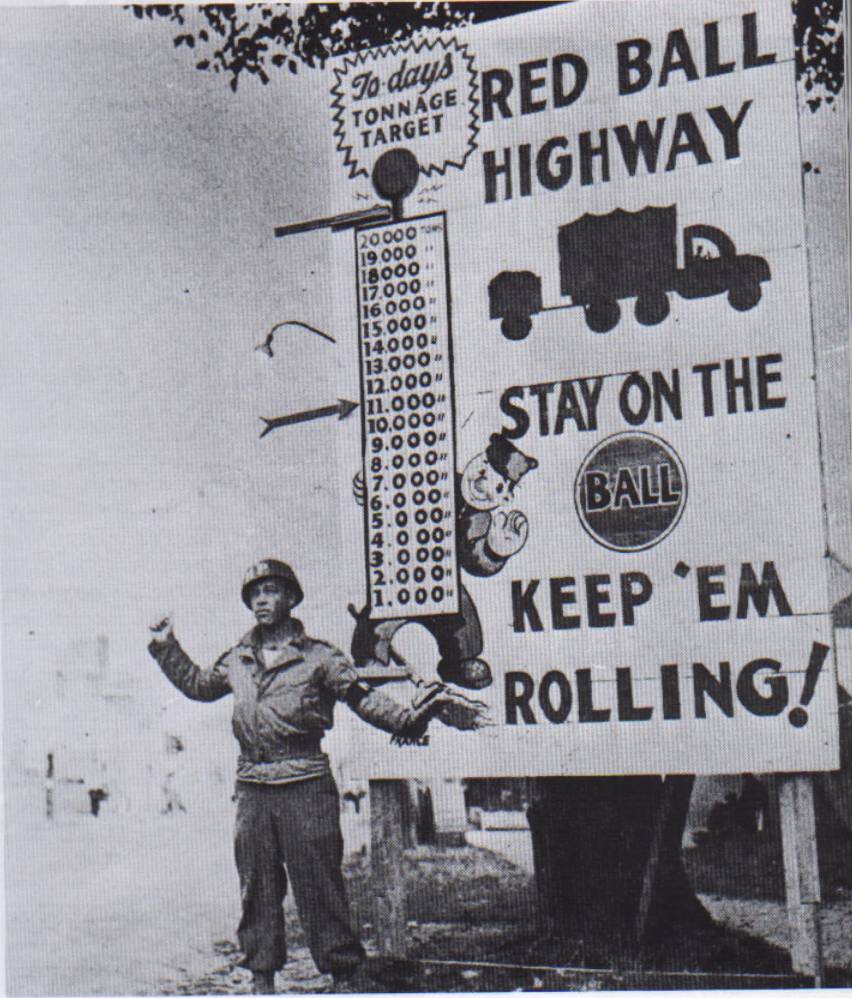
On the one-way street marked with a red ball, huge amounts of
supplies were sent to the front. Here on September 4, 1944,
11,000 tons were brought to a Central Distribution area
behind the front.

The term "Red Ball Express" was used first by the railway freight business in the United States. It meant "Express Freight Delivered at Top Priority". The Army adopted the term and created the "Red Ball Highway" that stretched from the ports in France to the front lines in Germany. To make things easier, the route was marked with a red ball. Trucks were painted with red balls. The troops conducting traffic wore red balls to mark the way. Nearly 75 percent of all Red Ball Express drivers were African American. At the Red Ball's peak, 132 truck companies were strung out with a round trip taking 54 hours, as the route stretched nearly 400 miles to First Army and 350 to Patton's Third. At its height the Red Ball saga captured the media's attention, and had the effect of placing supply and service personnel in the spotlight for a change. Still, the job was hardly glamorous, involving as it did endless hours of dull, hard, and sometimes dangerous work.


Soldiers load trucks with rations bound for frontline troops.
(L to R) Pvt. Harold Hendricks, Staff Sgt. Carl Haines,
Sgt. Theodore Cutright, Pvt. Lawrence Buckhalter,
Pfc. Horace Deahl and Pvt. David N. Hatcher
of the 4185th Quartermaster Service Company, Liege, Belgium.

Most of the following was excerpted from an excerpt of "POL on the Red Ball Express" by Dr. Steven E. Anders, Quartermaster Professional Bulletin, Spring 1989 as seen on the Army Quartermaster Foundation web site:

Mearl R. Guthrie, Red Ball Coordinator, B407

The Red Ball Express was one of World War II's most massive logistics operations, namely a fleet of over 6,000 trucks and trailers that delivered over 412,000 tons of ammunition, food, and fuel to the Allied armies in the ETO between August 25 and November 16, 1944. Quartermasters who for centuries gathered huge stockpiles of hay, barley, and oats to "fuel" past armies on the move, were now required to supply the petroleum, oil and lubricants (POL) that make up the U.S. Army's logistical lifeblood.

The Germans offered even lighter resistance than expected as success followed success in the Allied pursuit across France. As Patton's Third Army swept westward into Brittany and south to Le Mans, it burned up an average of more than 380,000 gallons of gasoline per day. By 7 August its reserves were completely exhausted. Patton had to rely on daily truck loads of packaged POL from the rear. Nevertheless, he managed to continue this highly mobile type of warfare, driving eastward for another three weeks, before being halted by critical shortages of gasoline.

Logistically speaking, the real turning point in the campaign came during the week of 20-26 August. At that time, elements of both the First and Third Armies were simultaneously engaged in rapid pursuit. They developed an insatiable thirst for gasoline, and consumed more during this one week than any time previously. Average consumption was well over 800,000 gallons per day. The First Army alone used 782,000 gallons of motor fuel on 24 August. The next day Allied forces closed in on the Seine and columns of U.S. and French troops entered Paris.

The decision to cross the Seine and immediately continue eastward, without waiting to more fully develop supply lines, posed serious difficulties for the theater logisticians but was a gamble senior commanders were willing to risk. "The armies," said General Bradley, on 27 August, "will go as far as practicable and then wait until the supply system in rear will permit further advance." Once across the Seine, forward divisions not only extended their lines, but fanned out in every direction creating a front twice as broad as previously. The strain on the supply system was immediately noticed as deliveries slowed to a trickle. The late-August into early-September operations were described by war correspondent Ernie Pyle as "a tactician's hell and a quartermaster's purgatory."

Believing victory to be firmly within their grasp, the fast-moving armies had outrun their supply lines and were forced to live hand-to-mouth for several days. 90-95% of all supplies on the continent still lay in base depots. First and Third Armies had in effect "leaped" more than 300 miles from Omaha beach in a month's time. In a desperate effort to bridge the gap between the front and mounting stockpiles back at Normandy a long-distance, one-way, "loop-run" highway system - dubbed the Red Ball Express - was born. Since circumstances allowed little time for advance planning or preparation, Red Ball was, as one observer noted, "largely an impromptu affair." It began on 25 August, with 67 truck companies running along a restricted route from St. Lo to Chartres, just south of Paris; and reached a peak four days later with 132 companies (nearly 6,000 vehicles) assigned to the project.

While the Engineers were busy maintaining roads and bridges, MPs were on hand at each of the major check points to direct traffic and record pertinent data. Colorful signs and markers along the way kept drivers from getting lost, and at the same time publicized daily goals and achievements. Quartermasters truck drivers, materiel handlers, and petroleum specialists were ever present both along the route and at the forward-area truck-heads. Disabled vehicles were moved to the side of the road, where they were either repaired on the spot by roving Ordnance units or evacuated to rear-area depots.

Round-the-clock movement of traffic required adherence to a strict set of rules. For instance, all vehicles had to travel in convoys and maintain 60-yard intervals. They were not to exceed the maximum speed of 25 mph and no passing was allowed. After dark, Red Ball drivers were permitted the luxury of using full headlights instead of "cat eyes" for safety reasons. At exactly ten minutes before the hour each vehicle stopped in place for a 10-minute break. Bivouac areas were set up midway on the roads so exhausted drivers could get some rest and a hot meal.

In late August, Eisenhower decided to forward most petroleum supplies to Hodges's First Army and Mongomery's 21st British Army Group. This action was to come at the expense of Patton's Third Army to the South. On 31 August, Patton's daily allotment of gasoline dropped off sharply from 400,000 to 31,000 gallons. This placed a virtual stranglehold on the fiery commander, who fumed, pleaded, begged, bellowed and cursed accordingly — but to no avail. "My men can eat their belts," he was overhead telling Ike at a meeting on 2 September, "but my tanks gotta have gas." The logistical crisis threatened to halt the Allies where the enemy could not.

Fortunately, that crisis proved to be short-lived. It would only be a slight exaggeration to say that Red Ball saved the day. The hastily conceived system served as a useful expedient for bringing Class III items, especially gasoline, quickly to the fuel-starved front. Even though First and Third Army supply officers would continue bemoaning the gas shortage, the situation got markedly better. By the end of the first week in September, forward area truck-heads were issuing POL as soon as it came in, and consumption rates were once again hitting the 800,000-gallon-a-day mark. Mid-September saw the two American Armies issuing in excess of one million gallons of gasoline daily — enough to meet the immediate needs and begin building slight reserves.

Red Ball was scheduled to run only until 5 September, but continued through mid-November, buying precious time for the rear echelon support team to complete its task of building up the railroads, port facilities, and pipelines needed to sustain the final drive into Germany. By this point the Red Ball Express had developed an inherent problem. As the route got longer and longer, the Red Ball required more gasoline — ultimately as much as 300,000 gallons per day — just to keep the Red Ball vehicles themselves moving.