06 October, 2011

06 October 1944

438th AAA AW BN
APO 230 % Postmaster, N.Y.
Germany
6 October, 1944         1030
Dearest sweetheart –

Another day another dollar and a day nearer my return. I got 2 more letters from you – the latest written the 24th. I also heard from Lieutenant Alexander. I get a kick out of that – knowing I have a brother who is an officer in this man’s army. He wrote his letter before graduation – so I don’t know yet how that came off. He knew his orders, however, and as far as they went – they’re not bad. I’m anxious for him to remain on the East coast and away from the Pacific. He’ll be able to get home of a week-end now and then and that will make Mother A feel a little it better.

So you were a stay-out late, huh! I don’t blame Mother B for waiting up for you. Hell – I can’t remember staying up so late since I don’t know when – oh yes; just the other night, dear, when we had a brawl. Other than that – only when enemy planes keep us up. Anyway – I’m glad you had a good time at Verna’s I don’t know Harold Shapiro – although I had heard him mentioned at Irv’s.

I’m interested at your reference to the conversation about Stan and Betty. The thing that interests me most is the fact that all of Stan’s closest and best friends seem to have discovered his bad points – all in the same period. I don’t quite understand it – because in all the time I’ve known Stan, I’ve never heard anything bad about him. And here is Irv mentioning his bad points. I’m confused also about their feeling badly about the match – I though Betty and Verna were such good friends. Oh well – it’s human nature I guess and that’s that. I do hope for Stan’s sake that it all turns out well. He’s had a pretty tough time of it all in all – and to his credit – he made the most of his opportunities. I think he’ll probably make a faithful husband – if his wife turns out decent. If not – I think he’ll wander, and that won’t be good.

I had never heard of the book ”Generations of Vipers” – and I don’t know Phillip Wylie. He sounds as if he had had some tough break or other with doctors and has sought vengeance thru the medium of a book. But thanks, darling, for defending the profession. People, professions, business – on the whole – have quite a mixture of good and bad points. I sincerely believe that there is less of the ‘bad’ in the medical profession than in any other. Willingly or not – there’s a good deal of sacrifice, free work, free counsel – and there isn’t a doctor I know who doesn’t get a thrill out of doing something constructive for a patient.

Say – I wish you wouldn’t smoke so much, dear. Now – your Mother isn’t around – so I can speak freely. The fact is – too much of it doesn’t do your lungs any good – and it definitely cuts down on your wind. I don’t want you gasping for breath after one of my special 12-15 minute kisses, Sweetheart. On the other hand – maybe I do!

Thanks again – for your effort in trying to get me a radio, darling. I had no idea it would be so difficult. Now I’m really glad I managed to get one in Liege – even if I did have to pay $80 for it. The one I have plays well.

It is again almost noon – dear – and I’ll stop here. I love you, darling – so very much and miss you terribly. I feel terrible about the delay in mail to you – but you know anyway – that I’m continuing to write constantly – come hell or high water. Love to the folks –

And my everlasting love –
Greg

* TIDBIT *

about The Hürtgen (Huertgen) Forest in Early October
and The First Attack on Schmidt


CLICK ON MAP TO ENLARGE


Most of what follows was published as "The Battle of Hürtgen Forest" at historynet.com.

Hürtgen. If a single word can cause a U.S. Army veteran of the European theater to shudder, it would be "Hürtgen". The foreboding image of dark forests, steep hills, voracious mud, pillboxes, constant rain and shells bursting in treetops immediately comes to mind. It was the sort of battlefield where soldiers walked a few feet from their foxholes and were never seen again.  What little has been written about Huertgen has often focused on the November 1944 battles involving the 28th Infantry Division and has ignored the horrible prelude to the "Bloody Bucket's" mauling, which occurred over 10 days in October.

The struggle for the 50 square miles of heavily wooded and hilly terrain south of Aachen actually began in mid-September. With their supply line stretched to the breaking point, the Allies' rapid advance through France had finally slowed down at the Siegfried Line, the formidable defensive belt that blocked Germany's western border and guarded the entrance to the Ruhr Valley. Hoping to seize Aachen and establish a firm breach in the Siegfried Line before winter's onset, Maj. Gen. J. Lawton Collins, commanding VII Corps, ordered Maj. Gen. Louis A. Craig's 9th Infantry Division to seize the villages of Hürtgen and Kleinhau. After some initial progress, the American drive stalled when two of Craig's regiments were diverted north to assist the 3rd Armored Division, which was embroiled in a brutal battle at the Aachen suburb of Stolberg.

In early October, Craig was ordered to resume his attack in the Huertgen Forest. Now, however, he would have to do so minus his 47th Infantry Regiment, which remained in support of the 3rd Armored, and with understrength units sent from the fighting around Aachen. To further complicate matters, Collins made it clear that the 9th Division's effort was regarded only as secondary — supporting the Allies' main attack at Aachen. That meant Craig would be at the bottom of the list for reinforcements, artillery or air support, though the general took some comfort knowing he was not expected to begin his assault until three days after VII Corps began its renewed push toward Aachen.

The villages of Germeter and Vossenack, as well as the crossroads settlement of Reichelskaul, were designated as the 9th Division's initial objectives. Lieutenant Colonel Van H. Bond's 39th Infantry Regiment would attack on the left. Once it had occupied Germeter, the 39th would seize Vossenack while guarding against an enemy counterattack from the north. Meanwhile, after capturing Reichelskaul, Colonel John G. Van Houten's 60th Infantry Regiment would reorient itself to the south to guard against a German counterthrust from the direction of Monschau. The division would then push on against the town of Schmidt. Jump-off time was originally set for October 5 but was later postponed for 24 hours.

What the Americans did not know was that hidden in the woods were thousands of German soldiers eager for an opportunity to administer a strong counterblow that would blunt the Allied drive into the Third Reich.

On October 1, Germany's LXXIV Army Corps directed Maj. Gen. Hans Schmidt to take over the entire Huertgen sector. Schmidt deployed Col. Schmitz's GR 983 (Grenadierregiment, or infantry regiment) in reserve while assigning the northern sector to Col. Heintz's GR 984. The center was allocated to Lt. Col. Tröster's GR 942, while the southern sector was the responsibility of Colonel Feind's 1,000-man Battalion 253, which was placed along the weakest portion of the line.

Each Grenadierregiment was almost a miniature division allowing its Oberst or Colonel considerable freedom of action in achieving their objectives. It had the usual three infantry battalions plus an infantry gun company, an anti-tank company, a pioneer platoon, and a reconnaissance platoon. The infantry gun company had three platoons each: two light 7.5cm infantry guns and one platoon of heavy 15cm infantry guns. These weapons gave the regimental commander his own artillery, even when the divisional weapons were unavailable. Because they operated well forward with the infantry, the infantry guns were also useful for direct fire at fortified positions. The anti-tank company started the war with four platoons of three 3.7cm guns apiece. Experience in France had already revealed the limitations of this small gun, so by 1942 most regiments were supposed to have one platoon equipped with heavier guns. Although these were supposed to be the 5cm anti-tank gun, there was a serious shortage of these weapons so many divisions found themselves issued the 7.5cm instead.

German Guns

CLICK ON IMAGES TO ENLARGE

7.5cm Infantry Gun


15cm Infantry Gun


7.5cm Anti-Tank Gun


3.7cm Anti-Tank Gun


The Americans knew few of these details when they began their attack at 1000 hours on October 6. Craig opened with P-47's dive-bombing at otherwise invisible targets that U.S. artillery units had marked with columns of red smoke. Once the planes departed, there was a five-minute preparatory heavy artillery barrage. At 1130 the U.S. foot soldiers began surging forward.

05 October, 2011

05 October 1944

438th AAA AW BN
APO 230 % Postmaster, N.Y.
Germany
5 October, 1944          0915

Good Morning, Sweetheart!

I can remember when writing you at 0900 was almost routine i.e. the time – and now that hour is an unusual one for me. I’d rather write you, dear, in the a.m. than later on because usually I’m less confused and haven’t been tearing around. I should have kept quiet – 2 patients just walked in and I have just returned to this after a 20 minutes lapse; and here I go again – 3 more –

Well, darling, it is now 1015 and I didn’t get very far. Nothing very important – just a lot of dressings. One case is a little more interesting than the others – a fellow who fell on his ear a couple of days ago and tore it almost in half. I repaired it but I’m watching him closely because cartilage heals very poorly and his laceration went right thru the cartilage. They’re all gone now and all I have to contend with now, I hope, is the office ‘help’ – which consists at present of 2 other officers and 7 enlisted men.

Last night, darling, I tried to break up the more or less persistent little blue streak I’ve had recently. Six of us apparently felt the same way because we dug up an old liquor supply and really tied one on by ourselves. We stayed up until all hours – singing, yelling etc. – and I’m glad to report – that in that respect, anyway – dear, I am not aging. Also – the next morning I am apparently unaffected – because although a couple of the boys couldn’t eat their breakfast – I have no after effects that I’m aware of.

Boy! You really got my mouth watering in your description of those Christmas Packages – topped off by brownies. And I don’t see why you won’t tell me what else is coming. After all – well never mind. I’ll “sweat it out”. I sure hope they come in good shape – most of them do, too, from what I’ve seen. I’ll thank you now, sweetheart, for your thoughtfulness.

It used to be so easy to send things to the States from England and in the early days – from Normandy – but now things are all fouled up. We hear all kinds of contradictory stories – that this or that may or may not be sent, that you can’t buy things to send home, that you can send one sort of souvenir and not another, and that some articles are kept by the censor and never returned. Anyway – I’ve got a couple of things I’m going to take a chance on, sweetheart, and I hope the package gets to you – and aaah – I won’t tell you what I’m sending.

Incidentally, dear, I had a ‘conference’ with my official packer and shipper in re the clock and I think we’re going to try to send it out. I might as well take a chance because I don’t see how I can get it home any other way, dear.

Your letter telling me about your being able to wait if I can – was sweet, dear; I guess you know how it is with me. I love you, sweetheart, more than anything else in the world, I want you to be my wife – that is, my first and most important goal when I return. I was thinking about it the other day – and it occurred to me that I will be a mighty busy fellow when I get back. These are the things I’ll want to do – and all at about the same time: 1. Marry you dear 2. Buy a car 3. Decide where my office will be located and probably refinish my furniture 4. Decide with your advice and help where we’ll live 5. Furnish the place where we’re going to live 6. – and not in the right order – Have a honeymoon. Sounds like fun – darling, doesn’t it? For after all – you will be an integral part of it all.

In case you don’t know it – darling, it is now 1115 – which gives you an idea of how hard it is to write sometimes without interruption. I guess you find it the same when you write from your office. I’m so glad you are working dear – because it must be making your time go much better.

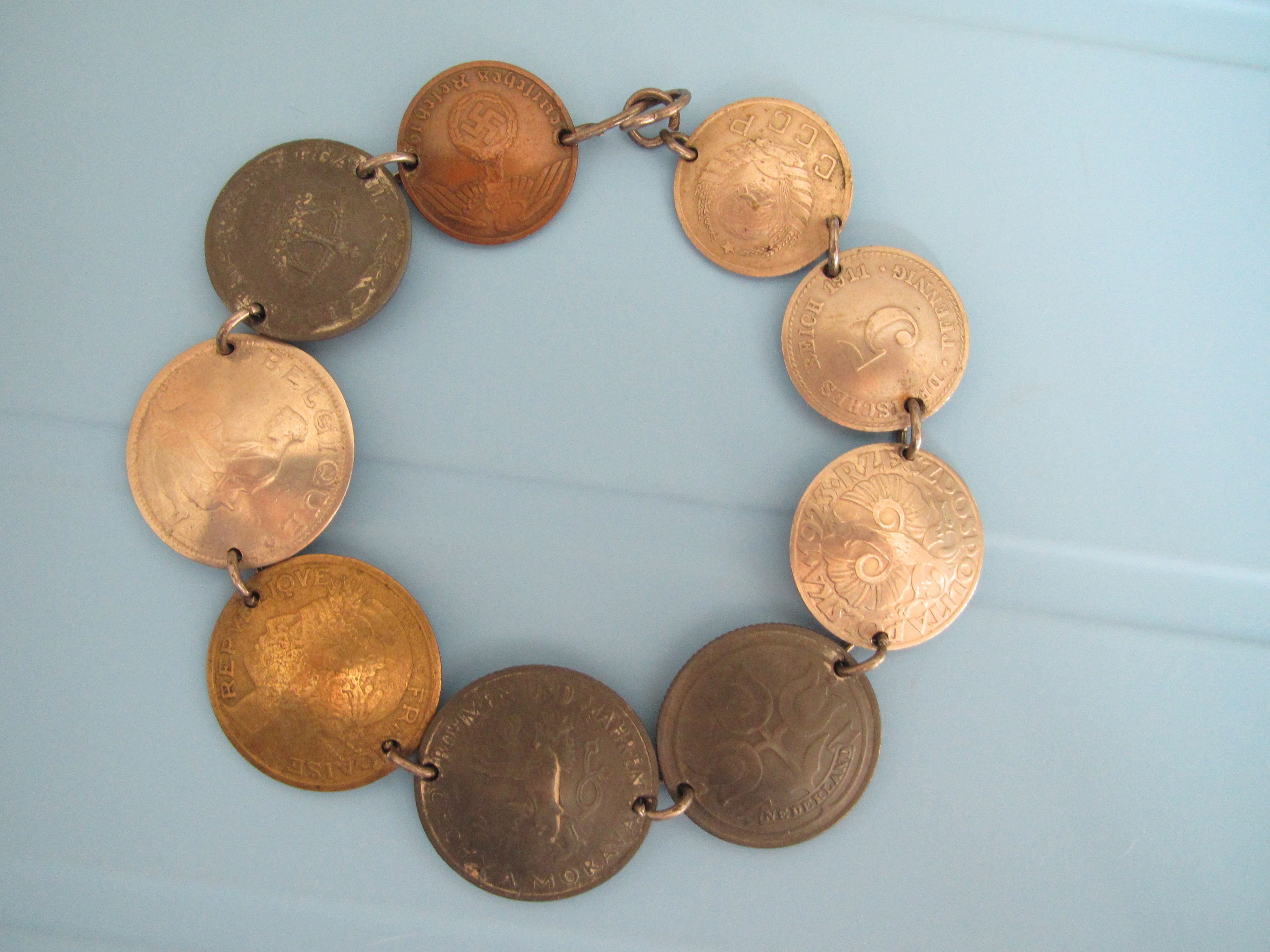
Before I close – the enclosed ‘bracelet’ was made by the same fellow in my medical detachment, but this time I got hold of the coins from various sources – and you have a chunk of Europe there. Unfortunately these coins don’t hold a polish – and we can’t get any silver plating done – although that would be the thing to do. Anyway – do with it what you wish, dear.

Coin Bracelet Top and Bottom

CLICK ON IMAGES TO ENLARGE

Top, Clockwise from clasp: 1939 Soviet 10 Kon, 1911 German 5 Pfennig,
1925 Polish 20 Groszy,1942 Netherlands 10 cents, 1941 Protectorate of Bohemia and Moravia (Czech Republic today) 1 Koruna, 1938 French 1 Franc, 1933 Belgian 1 Franc, 1941 Romanian 2 Lei, 19? German 1 Pfennig

All for now, sweetheart. Must close now – with love to the folks and

All my deepest love to you.
Greg.

* TIDBIT *

about The Protectorate of Bohemia and Moravia

One of the coins on the bracelet Greg sent to Wilma was from the Protectorate of Bohemia and Moravia. Most of the following information on that land comes from Wikipedia.

The Protectorate of Bohemia and Moravia (German: ; Czech: Protektorát Čechy a Morava) was the majority ethnic-Czech protectorate which Nazi Germany established in the central parts of Bohemia, Moravia and Czech Silesia in what is today the Czech Republic.

CLICK ON MAP TO ENLARGE

It was established on 15 March 1939 by proclamation of Adolf Hitler from Prague Castle following the declaration of the establishment of the independent Slovak Republic on 14 March 1939. Bohemia and Moravia were autonomous Nazi-administered territories which the German government considered part of the Greater German Reich. The Gestapo assumed police authority. Jews were dismissed from the civil service and placed in an extralegal position. Political parties were banned, and many Communist Party leaders fled to the Soviet Union. The population of the protectorate was mobilized for labor that would aid the German war effort, and special offices were organized to supervise the management of industries important to that effort. Czechs were drafted to work in coal mines, the iron and steel industry, and armaments production; some young people were sent to Germany. Consumer goods production, much diminished, was largely directed toward supplying the German armed forces. The protectorate's population was subjected to strict rationing.

German rule was moderate during the first months of the occupation. The Czech government and political system continued in formal existence. Gestapo activities were directed mainly against Czech politicians and the intelligentsia. The eventual goal of the German state under Nazi leadership was to eradicate Czech nationality through assimilation, deportation, and extermination of the Czech intelligentsia, not just here but throughout all of Europe. The intellectual elites and middle class made up a considerable number of the 200,000 Protectorate people who passed through concentration camps and the 250,000 who died during German occupation. It was assumed that around 50% of the Czechs would be fit for Germanization.

On 27 September 1941, the Reich adopted a more radical policy in the Protectorate. The Czech government was reorganized, and all Czech cultural organizations were closed. The Gestapo indulged in arrests and executions. The deportation of Jews to concentration camps was organized, and the fortress town of Terezín was made into a ghetto way-station for Jewish families. Of the Czech Jews who were taken to Terezin, 15,000 were children. Only 132 of those children were known to have survived.

SS hardliner Reinhard Heydrich was appointed Deputy Reichsprotektor of Bohemia and Moravia. He died on 4 June 1942, after being wounded by an assassin. Following directives issued by Heinrich Himmler, Heydrich's successor, mass arrests, executions and the destruction of the villages of Lidice and Ležáky were ordered. In 1943 the German war effort was accelerated, and some 350,000 Czech laborers were dispatched to the Reich from Bohemia and Moravia. Within the Protectorate, all non-war-related industry was prohibited. Most of the Czech population obeyed quiescently up until the final months preceding the end of the war, while some thousands were involved in a resistance movement.

Non-Jewish Czech losses resulting from political persecution and deaths in concentration camps totaled between 36,000 and 55,000. The Jewish population of Bohemia and Moravia (118,000 according to the 1930 census) was virtually annihilated. Many Jews emigrated after 1939 but more than 70,000 were killed. 8,000 survived at Terezín and several thousand Jews managed to live in freedom or in hiding throughout the occupation.

The extermination of the Romani population was so thorough that the Bohemian Romani language became totally extinct. Romani internees were sent to the Lety and Hodonín concentration camps before being transferred to Auschwitz-Birkenau for gassing. The vast majority of Romani in the Czech Republic today are actually descended from migrants from Slovakia who moved there during the post-war years in Czechoslovakia.

The existence of the Protectorate of Bohemia and Moravia came to an end in 1945 with the surrender of Germany to the Allies of World War II and the reconstitution of Czechoslovakia. In 1993, the Republic of Czechoslovakia was divided into the Czech Republic and Slovakia.

04 October, 2011

04 October, 1944

Letterhead

438th AAA AW BN
APO 230 % Postmaster, N.Y.
Germany
4 October, 1944          1000
My darling –

Well yesterday evening we got some mail and was it welcome! In the first place I got three letters from you – 15, 19, 22nd Sept; I got one from Florence – she’s darned nice about writing and I really enjoy hearing from her; a V-mail from my brother telling me he was practically a Lieutenant; and surprise – a 5 page V-mail from Stan. It all made good reading but yours were the ones I wanted most of all.

Stan’s letter was one of apology for not having written before. He explained how busy he has been and told me about Betty, saying she was the most wonderful girl he had ever met. He sent his regards to you and said that he hadn’t called anyone when he came home of a week-end because he got in Saturday p.m. and left Sunday p.m. Apparently he had not yet received my letter and he is no longer living at a hotel but has an apartment. I’ll write him and wish him luck again.

Lawrence’s letter made me a bit sad. His commission is coming thru, but I hate to think of him as a soldier, and I’m afraid of where his orders may send him. I fear he’ll eventually end up in the Pacific and that’s not good.

Your remarks about what Verna had to say about my letter to her interested me. I hardly remember referring to what Irv was doing, but apparently I did, and I’m glad they both liked it, whatever it was. I owe her a letter, by the way, and will answer her one of these days. I’ve been wondering when you’d find out I had passed thru Belgium. You seemed surprised – and I suppose that’s natural. But I don’t see how you thought I was in Southern France when you believed I was with the Third Army. We headed due East after passing to the South of Paris and then swung North. We weren’t in Belgium very long as you must know by now.

As for post-war adjustment – and the returning soldier, I suppose it will be tough on some. Somehow I feel that I will be able to take up where I left off – darling, and I don’t believe that you’ll have any difficulty whatsoever as a “have-not” in adjusting yourself to me who has witnessed some of the rotten things of war. It will harden many, no doubt, but as I wrote from way back in Normandy, I don’t believe I will have changed much. Where a doctor changes most as a person is about in his last year of medical school and as an intern. He first sees then, I believe, how cheap life can be – and war is just a multiplication of death – if you leave ideology out of the discussion. No, I’m sure we won’t have any difficulty with adjustments, darling. I think you’ll find me, God willing, the same sort of person I was when I left – and if that’s all right with you – everything will be fine, I know.

I had almost forgotten about the clock, dear, until you mentioned it in your letter. To tell the truth I hardly remember what it looks like it’s been so long since I saw it. I had it boxed up by one of my boys. All I can tell you, dear, is that it’s a French clock – Paris manufacture, I believe, and mantlepiece style. As I remember it, it must be about 12 or 15 inches long, about 10 inches high and about 6 inches thick. It is rather ornate – as are most French clocks – and why I got it was because of where it came from; it belonged to a Rothschild. I don’t see how I can ever get it home, but I’ll continue to hold on to it.

Oh – one more thing before stopping, dear. I didn’t want you or your Dad to bother about a radio. If my Dad can’t get one – it’s O.K. – and don’t trouble yourself about it. Promise!

I’ll stop now and get a couple of things done. We expect a visitor this p.m. – but visitors don’t bother us as much as they used to. After all – what can they do to us if they don’t like something? Love to the folks darling; it was swell hearing from you – and for now, so long, and

My everlasting love,
Greg.

P.S. Enclosed is a badge worn by Nazis before Hitler was in power and therefore of questionable historic value.
L.
G.

* TIDBIT *

about Raeren and
the German-Speaking Community of Belgium

The city of Raeren, where Greg was living in early October of 1944, is known far beyond its borders for pottery – and not only because of the annual Euregio-Ceramics Market in September. The district of Raeren has been a center for the production and export of ceramic stoneware since the 15th century. The geography is perfect for potting, a rich loamy earth, with plenty of clear running water and enough woodland to fire the kilns. In the 16th and 17th centuries up to 300 kilns were running at full output, but by the 19th century, Raeren's ceramics industry was beginning to die out.


From the Workshop of Jan Emens Mennicken
dated 1591


15th Century Stone Bottles


From the Workshop of Jan Emens Mennicken
dated 1595

Today, archaeologists still stumble on regular ceramic-cemeteries, where earlier generations dumped their defective or damaged production. Some of the finest examples from this period can be found at the pottery museum, (Töpfereimuseum), in the moated Raeren Castle, built in the 14th century.

Raeren Castle


Another of Raeren's treasures is its old railway station, the home of the "Vennbahn". This single-track railway was built at the end of the 19th century to link Prussia with Lorraine. The rail was also strategically important in the war years for moving troops to and from the barracks and military range at Elsenborn in Bütgenbach. Until 2002 the Vennbahn still rocked tourists gently up through the High Fen.

Old Trains in Raeren

CLICK ON IMAGES TO ENLARGE


Raeren is part of the German-Speaking Community of Belgium. A few days after Hitler’s troops had invaded Belgium, the Führer adopted a decree to annex the regions of Eupen and Malmedy and several sections of the territory that once belonged to the region called "Alt-Belgien" to the Reich. After the liberation of the region by the Allied forces, it was put under Belgian control again. The execution of a treaty between Belgium and Germany in September 1956 put an end to the questions concerning the border that had remained unanswered. Both countries agreed on a border adjustment, a cultural agreement and war indemnity payment. These bilateral decisions made way for reconciliation and cooperation, which was very advantageous for Eupen and Sankt Vith.

The German-Speaking Community today is a political independent entity, a small state within the Belgian federal system. The German-speaking Community has about 75,000 citizens, for the most part German-speakers. Its territory, about 854 square kilometers, corresponds to that of the German language region. It is composed of nine municipalities. German is used in administrative, educational and court matters. The French-speakers receive special language rights called “facilities” i.e. they get administrative documents in French.


Coat of Arms

The territory consists of two distinct parts: in the North, the "Eupener Land" (district of Eupen) is small, but heavily populated and in the South, the Belgian Eifel (district of St Vith).


The German-speaking Community is perfectly linked to an international road network; you can reach Eupen in one hour’s drive from the congested areas of Brussels, Cologne and Düsseldorf. It is also connected to the Euregio Meuse-Rhine territory and to the cross-border cooperation area Saar-Lor-Lux. Many persons working in Germany or in Luxembourg live in the German-speaking Community.

The people of the Community identify themselves with the German language and are linked to German culture through the media and daily cross-border contacts with Germany. They enjoy the direct neighborliness of the Walloons and the Flemish and share their rather unworried lifestyle. They are loyal Belgians, mainly in favor of the Monarchy; they feel respected by the State since German has been recognized as one of three administrative and constitutional languages. The political recognition of the German-speaking Community has contributed to the fact that the German-speaking population considers itself as an integral part of the Belgian State. Most of the inhabitants speak High German in administration, schools, churches and social fields. However, like before, dialects still play an important role in the social relationships. There is a French-speaking population minority mainly in the municipalities of Kelmis, Lontzen and Eupen. However, on account of the Belgian territorial principle, no survey has been conducted into the ratio of French- and German-speakers.

03 October, 2011

03 October 1944

V-MAIL

438th AAA AW BN
APO 230 % Postmaster, N.Y.
Germany
3 October, 1944          1045
Hello darling!

Well a year ago I was sweating out one alert after the other and we were managing to see each other as often as possible. Those were days I’ll never forget and I’m sure we’ll talk them over many times in the future. I’ll never forget my reactions, either when I sailed out of New York harbor. I wondered what would ever happen to us and I was so afraid I’d lose you, dear. I’m so happy I didn’t, although I still feel you were very brave in being willing to wait for me. But it can’t be much longer, darling – and one of these days I’ll be taking you to me and holding you so tight a quick glance would make one think we were welded.

Kind of busy today, dear, with a couple of things to do this p.m. If I get through in time I may be able to see a U.S.O. show which is visiting our battalion today. That will be the first one since England – and although they’re usually not very high class – what the heck – after all, this is Germany. Will stop for now, dear, my love to the folks – and remember – you have
All my love –
Greg.

* TIDBIT *

about The History of the U.S.O.

02 October, 2011

02 October 1944

438th AAA AW BN
APO 230 % Postmaster, N.Y.
Germany
2 October, 1944        1600

My darling –

This should be a V-mail, dear, because I’ve got a good many things to do – but I know you don’t like V-mails and so I’m writing this. If I do use the short form, sweetheart, you can always be sure it was the only way out for that particular day.

The weather finally cleared this morning and the sun sure is welcome. It has been about two weeks since we last had a decent day. I had to travel about a bit this morning and part of this afternoon to investigate a couple of injured soldiers. On the way back I managed to get a warm shower – although the temperature was not conducive towards enjoying it – i.e. the temperature outside. These quartermaster showers – if I haven’t told you before, dear, are rigged up in large tents – but they are open at either end and at the sides.

Yesterday – early evening we got some mail again and I got a letter from you – dated 13 September and one from Eleanor of the same date. Eleanor’s letter was in response to one of mine asking about my checking account balance. Every now and then I wonder what it is because it keeps changing because of insurance coming due, monthly payments for shares etc. I think my present balance is too high and I’ll write Eleanor to deposit some of it in my saving account where I get some interest. One thing I’m glad about, darling, and that is that I had the foresight some time ago to get started on some life insurance even though I didn’t have a wife or family. I will have both one of these days, darling, and insurance is a good thing to have. Before I even met you, dear, I converted my army insurance – which is term insurance and expires on discharge – to regular insurance – 20 payment life, for a higher fee of course – but worth it, I believe.

I was interested in your remarks about “Paris Underground”. I haven’t read it – of course – but I sure have had first hand information about it. Life was certainly hazardous for the workers, from what I gathered, but in my opinion, the Belgian underground, less heard of, was far more bold and efficient. By the way, as I wrote you some time ago, the only book I’ve read recently was “Roughly Speaking”, by Louise Randall Peirson.

CLICK ON IMAGES TO ENLARGE
  

If you haven’t gotten to it as yet I certainly recommend that you do. It’s one of the funniest yet human books I’ve read in a long long while and I’m sure you’d enjoy it, dear. I’ve got two more books from Special Service – one is “My Son, My Son” – which is a couple of years old but which I failed to read. I believe it was good. The other is the famous little book “The Education of Hyman Kaplan”. I’ll get started on one of them tonite if we don’t play bridge. We had another swell game last nite; the Colonel and I were partners and we trimmed our opponents. I played better than usual – but managed to foul up a small slam hand which I bid correctly but played poorly. We went down two.

I got a chuckle out of your reference to Shirley Bernstein. Red hair now! If you want to know what I think, I’ll tell you. She’s wacky! At best she is only shining in the glow of her brother’s success – and that is flimsy glory.

And what do you mean by feeling wonderful about “being independent for awhile” anyway? Darling you’ll be independent as my wife, too – don’t forget that – even if I have to go house to house asking if anyone’s sick!

All for now Sweetheart, I really must go – but not before giving you one big long hard ethereal kiss and all the love that it imparts. My best to the folks – and to you –

My deepest love and affection
Greg.

* TIDBIT *

about The End of the Warsaw Uprising

From the "Warsaw Life" web site comes this:

In the Summer of 1944 the tides of war were turning against the Germans. The Americans and British had landed in Normandy and the Red Army had bulldozed through the Eastern front, and was marching on Warsaw. Ever since the beginning of the Nazi occupation the Poles had been preparing for a full-scale underground offensive, and on 1st August 1944 the order was finally given by General 'Bor' Komorowski for the forces of the Armia Krajowa (AK) to rise up and claim Warsaw back from the Nazis, who had held the city for over four years.

A force of 50,000 soldiers, some trained and equipped - others volunteers (including women and children), began an assault on key strategical positions throughout the city. The Home Army won several bloody skirmishes in those first few days, and the Polish national flag flew over the Old Town. The mood was triumphant and, in those areas secured by the insurgents, the Varsovians held concerts, poetry readings and other entertainments as they celebrated their newly earned freedom. It was to be the city's last taste of freedom for forty-four years.

The Polish attack planned to displace the German troops stationed in the city, was planned only to hold the town for several days until the Russians arrived with support. Far from coming to the rescue of the doomed Poles, Stalin halted the Russian advance, claiming that the resistance was illegal and the AK were 'fascists'. The mighty Red Army did little more than watch the struggle from across the Vistula as the Germans regained control of the city. What's more, kindly 'Uncle Joe' deliberately obstructed the rest of the Allies from dispatching aid to the insurgents - refusing even to allow the Americans and the Brits to use precious airbases that were now under Soviet control. Upon hearing the news of the Uprising, Himmler was so furious that he decreed that the whole city and its population should be destroyed as an example to the rest of Europe.

Simply put, Stalin hated the Poles, considering them his arch-enemy. He was still harboring resentment over the Soviet-Polish War in which the Bolsheviks were humiliated and the Poles were able to claim all disputed territories from the Russians, including Lwow (now Lviv, in the Ukraine) and Wilno (now Vilnius, in Lithuania) - the same struggle in which he was almost court-martialled for his inadequacies as a military commander. Now that the Germans were doing such a good job of destroying his bitter enemies, Stalin certainly didn't want to stop them. Moreover, with the last of Poland's home-based soldiers and leaders destroyed, he would be free to work his will over the ruined country.

Thus, what was supposed to be a 2-3 day coup turned into a brutal and bloody 2 month struggle for the Home Army. The heavily reinforced Germans struck back at the insurgents with the full force of their firepower: tanks, rocket launchers, and air raids were just some of the hazards the ill-equipped Poles had to contend with. The city became a giant war zone and civilians were not spared. Just a few days after the Uprising began the Germans sent a chilling message to the insurgents, executing at least 30,000 citizens in what is now referred to as the Wola massacre. They rounded up people from the houses in the districts which they still controlled and shot them - women, children and the elderly were not spared. This inhumane genocide was intended to crush the Poles spirit for the fight. It didn't work. However, another diabolical tactic - using female civilians as human shields for German tanks - proved effective, stacking the odds further against the beleaguered Home Army.

Unable to compete with the reinforced German troops, the insurgents were forced into hiding, often into the sewers, from where they continued to orchestrate and co-ordinate attacks. The Germans were in control of water and power supplies whereas the Home Army were desperately lacking supplies of any kind - including food and ammunition. Every animal in the city had been eaten, including the vermin. As the battle for the city raged on, with Varsovians dying at a rate of 2,000 a day, it became only a matter of time before the rebels were forced to capitulate. They finally did so on October 2nd, 63 days after the Uprising began.


Out of the sewers...

In the two month struggle 18,000 Home Army soldiers died and 12,000 were wounded with the survivors either sent to German POW camps or managing to go into hiding. A staggering 250,000 civilians were killed during the Uprising. Meanwhile the Germans suffered 10,000 fatalities with nearly as many again wounded. After his triumph, Hitler ordered special units to be brought in to systematically detonate any building of the remotest importance to Polish culture. The city was effectively destroyed block by block, and when the Russians finally crossed the Vistula to liberate the city, they inherited only ruins.

CLICK ON IMAGES TO ENLARGE


With Warsaw out of the way, the Soviets faced little organized opposition in establishing a communist government in Poland. Later, in the years directly following the War, as the Poles tried to rebuild their shattered country under Communist leadership, it was forbidden to talk of the brave soldiers of the Uprising. The movement was denounced as illegal and every effort was made to slander those involved. Keen to behead Polish society of its heroes and intelligentsia Stalin sent many of the surviving members of the AK to Siberia for lengthy spells of hard labor, whilst he executed those whom he perceived as particularly dangerous.

Here is a 48 minute video on the Warsaw Uprising of 1944.
It is worth the time it takes to watch.

01 October, 2011

01 October 1944

438th AAA AW BN
APO 230 % Postmaster, N.Y.
Germany
1 October, 1944       1430
Sunday
My dearest sweetheart –

Last night as I lay in bed I got to thinking how nice it will be when I can tell you all the things I’m thinking about, worrying about and dreaming of. All my life, it seems, I’ve kept my thoughts and problems to myself. It will be wonderful to have you to confide in, to help me with my problems, to allow me to think out loud.

I’ve been pretty blue the last couple of days, darling. I don’t know whether it’s due to the discouraging weather, or what – but I’ve felt the war just a little bit more today, yesterday and the day before. Tomorrow is 27 months of continuous Army service – and probably it seems longer because I’ve been with the same outfit all the while. It’s been a good outfit to be with – but I can’t hide the fact that medically speaking – it has been a complete waste of time. I guess that’s what really has me down. Oh – I’ve felt like that before and gotten over it, and I’ll get over this too – but I feel better just telling you about it, dear, even though I know it’s not fair to write you I’m blue. That’s one of the penalties you have to pay for being such a sweet and understanding fiancée.

I got to the point this morning – that I went to the First Army Surgeon, advance Section, and managed to find him in. I told him I was completely stale and asked him if there weren’t something I could do. He referred me to the personnel officer at Base Section and I’ve just come from there. The man I wanted to see was out, but I saw his representative. He told me there were other MC’s in the same position and with more time in service, but that Army was doing its best to reassign some of us. At any rate, he’s got my name on the list, but I don’t have much hope along that line. On the other hand, of course, is the probability that when this is all over that the fellows stuck in the hospitals will be the last to get out and that I might get out earlier for being in a separate battalion. The future holds that answer – as it holds so many others concerning us. One answer we don’t have to worry about though – and that is that I’m coming back to you, to marry you and live happily ever after.

I got a couple of letters yesterday – one from Lil Zetlan and one – a circular letter – from the Salem Hospital. I’m enclosing the latter. You may as well become acquainted with some of the names, dear, because you will eventually.

By the way, sweetheart, I was glad to read about Herb Zakim trying to date you. There’s nothing a fellow likes better than to feel that his fiancée or wife is attractive to others – as long as she is the faithful type; and about that I have no fear. And as to the reverse – you have never exactly asked me, but I can tell you anyway – you can and will be able to trust me, darling.

The enclosed little emblem was pinned on me by some enthusiastic Belgian some time ago. I’ve intended to send it along before but have forgotten up to now. You might like to wear it or save it. Thousands of these little emblems with the Belgian colors were to be seen in Belgium, this shape and a hundred other styles.

Well, sweetheart, I feel better now – having written to you. Everything will turn out all right, one way or another. Most of all I want to come home and marry you and show you how much I love you. Love to the folks, dear - and

My deepest love,
Greg

* TIDBIT *

about The Battle of the Huertgen Forest
First Attack: September

From a thread on the Axis History Forum web site comes this paper which was awarded the Loyola University History Award for Outstanding History Senior Thesis for the 2001-2002 Academic Year.

The Huertgen Forest: The Necessary Battle
by: Craig Bayer

There were three main army groups that would march into Germany. The first was the 21st Army Group under the command of Field Marshall Montgomery. They were still in the Holland area where Market Garden had taken place. Above Switzerland lay the 6th Army Group. Between the 21st Army Group and the 6th Army Group was the 12th Army Group under the command of General Omar Bradley. It consisted of the First, Third and Ninth armies. General Courtney Hodges was the commander of the First Army. Under Hodges were Major General Lenard Gerow, commander of V Corps, General Joseph Collin, commander of VII Corps, and General H Corlet, commander of XIX Corps. VII Corps consisted of the 1st and 9th Infantry Units and the 3rd Armored Division. V Corps controlled the 4th and 28th Infantry Division and the 5th Armored Division. In early September, General Hodges had to give these troops the order to halt, while supplies were moved to Montgomery to make way for Market Garden. General Collins and VII Corps lay west of the German town of Aachen at the Netherlands/Belgium border....

"The 9th division was given the task of clearing the northern section of the Huertgen Forest to prevent its use by the enemy as a base from which to counterattack or place fire against the south flank of the 3rd Armored as it drove head on against the West Wall."
         - General Joseph Collins

General Collins would send the 1st Infantry Division to take the foothill surrounding Aachen and have the 9th Infantry Division capture the northern part of the Huertgen Forest. The 3rd Armored Division would then be free to attack the Siegfried Line. Intelligence estimated that the Germans had only 7000 men defending the area, mainly from the 105th Panzer Brigade and the 116th Panzer Division. The German commander in charge of the defenses at the Stolberg area was General Brandenberg. He believed that the Americans would concentrate their attack on the city of Aachen. On 13 September the attack had begun and by 15 September the 1st Division had captured the ring of hills around Aachen. The 9th Infantry Division managed to take the town of Zweifall in the north area of the forest with little trouble. On 16 September, despite heavy resistance, the 9th Infantry Division was able to capture the town of Vicht and advance on Shevenhutte. With their flanks protected, the 3rd Armored Division began its assault on the Siegfried Line.

CLICK ON PICTURES TO ENLARGE

A column of GIs ascends a hill and enters the forest.
Many of the men sent into the woods as replacements
were unprepared for what they would face.

Their initial success was due to Germany’s miscalculation of the American objectives. However, as the fighting continued, it became more and more obvious to General Brandenberg that the American attack was not towards Aachen and more likely towards Stolberg. Major William Sylvan, General Hodges aide-de-camp, was extremely worried about the American position once the surprise was up. “Colonel Dixon reported today, based on intelligence he had, the Germans now resolved to throw in everything on the present line in an attempt to hold the Americans before they could crack the defenses along it.” The Germans sent in the 7th Army Group to stop the attack. On 17 September the 12th Division of the 7th German Army group counterattacked the American 3rd Armored Division in the town of Stolberg, where the Americans took heavy losses and were halted in their tracks. On September 18, Collins had the 3rd Armored Division retreat.

The Germans laid an all out attack on the Americans and the fighting was brutal. The Americans had managed to gain a foothold in the northern part of the Huertgen Forest and the hills around Aachen, but the main objective had failed. The Americans’ initial success was due to the fact that the Germans believed the main American attack would focus on Aachen and had left the Stolberg Corridor and the Huertgen with minimal defenses. When the Germans realized their mistake they were able to counterattack and throw the Americans off base. By 13 September more German reinforcements had also begun arriving in the forest to further improve the defense.

The ill-supplied Americans were inexperienced and did not know how to fight against pillboxes. Their training at home had not taught them the techniques they would need to survive in the wooded areas. “When the Germans, secure in their bunkers, saw the GIs coming forward, they called down presighted artillery fire, using shells with fuses designed to explode on contact with the treetops. When men dove to the ground for cover, as they had been trained to do and as instinct dictated, they exposed themselves to a rain of hot metal and wood splinters. They learned to survive a shelling in the Huertgen by hugging a tree. That way they only exposed their steel helmets.” The Americans, as Sgt. Mack Morris reports, had not realized the extent of the German defenses in the forest. “In one break there was a teller mine every eight paces for three miles. In another there were more that 500 mines in the narrow break. One stretch of road held 300 teller mines, each one with a pull device in addition to the regular detonator. There were 400 anti tank mines in a three-mile area.”


Artillery-damaged Treetops in Huertgen Forest

Even if it had achieved its goals, the first attack into the forest was a complete failure because the Americans were not going after the Roer River dams.

30 September, 2011

30 September 1944

438th AAA AW BN
APO 230 % Postmaster, N.Y.
Germany
30 September, 1944       1100
Dearest sweetheart –

This is Saturday morning and besides the usual Saturday weekly report I have to submit, there are the monthly ones due today also – so I should be busy, but with a good staff sergeant and an administrative officer – all I have to do is sign a mess of papers, look them over and pass them on. Oh hum, dear – I’ll really be spoiled. Let’s see, you can type, add and subtract – and in addition to all that, you can sit on my lap. Boy! – you ought to make one swell secretary! And from the dream I had last night – you’re going to make a swell wife. What a dream! What a dream! Jeepers – if I weren’t so sophisticated, I think I’d blush – just thinking about it – because after all, darling, we’re only engaged. But then – in the dream – you were my wife, so it’s O.K. dear, don’t worry. I hadn’t dreamed about you or us for a long time – but it certainly was swell seeing you again. For no matter how much you look at a picture, or close your eyes and try to imagine someone, there’s nothing like the vision of person in a dream to make the person seem real – except reality itself, of course, and that’s something we’ll have to wait for, I guess.

Yesterday was a quiet, dull day, dear. We waited all day for the mail – but there was none. In the evening we had a swell meal – garnished by fresh corn-on-the-cob – the first we’ve had – and procured from a nearby garden. After that we played poker until about 2145. I won 11 marks. Invasion marks – issued by the U.S. have a value of 10 cents. I don’t know what a mark was worth according to the Germans, although a Belgian some time ago told me the Germans arbitrarily fixed the marks as being worth 12 francs – which means they made it worth 24 cents.

Today is dull again and wet – but it’s nice and warm and comfortable inside. We have two scheduled attractions lined up today (a) the Red Cross Club mobile is supposed to visit us today with donuts and hot coffee. We’ve had them once before – and the line batteries several times. They really are welcome and again I have to say that R.C. is doing a bang-up job over here. (b) a movie – title not announced. The last movie we saw was “The Bridge of San Luis Rey” – an oldie, but we take them all in stride. We did see the premier in the world, I guess, of “Casanova Brown” – with Gary Cooper – a couple of weeks ago. It was fair.

Well sweetheart – what with interruptions, etc. – it’s time for lunch and so I’ll close – reminding you that I love you deeply, warmly, fully – completely and I always shall. Love to the folks, dear – and

All my everlasting love,
Greg.

* TIDBIT *

about American Red Cross Clubmobiles


The following is taken directly from an article written by Elma Ernst Fay which can be found on the Red Cross Clubmobile website.

CLICK ON PICTURES TO ENLARGE

Group K Clubmobilers
Charlotte Colburn, Marianne Shellabarger and Elma Ernst
Leicester, England 1944

In World War II the American Red Cross was asked by the U.S. Armed Forces to provide recreational services to the servicemen in the various theaters of operation. In Great Britain, the Red Cross began setting up service clubs in London and towns near army installations. Shortly thereafter, on air bases, aero clubs were set up. Because of the great difference in pay between American servicemen and their counterparts from other countries, as Great Britain, the army asked the Red Cross to make nominal charges for food and lodging.

The Red Cross clubmobile was conceived by the late prominent New York banker, Harvey D. Gibson, Red Cross Commissioner to Great Britain, who wanted to put a service club "on wheels" which would reach the serviceman at his camp or airfield. Also, by having a club on wheels, the Red Cross was able to get around the Army's request that servicemen pay for food. Everything distributed on a clubmobile was free. The clubmobile in Great Britain was a remodeled London Green Line bus that could be taken to the airfields and camps. Driven by an English driver, three American girls were assigned to each clubmobile.


Charlotte, Marianne and Elma

Clubmobiles began operation in Great Britain in late 1942, eventually covering some thirty bases and docks at Liverpool, Greenoch, Scotland, and Belfast, Ireland. The American girls who chose this service were taught to make the doughnuts and coffee in the clubmobile. They were sent to a town near American army installations, and followed a routine of going to a different base each day, hooking up at a mess kitchen, making hundreds of doughnuts and preparing coffee, and then driving around the base, serving the men at their work. They also distributed cigarettes, life savers and gum, and had the loud speakers tuned up for each stop.


The clubmobile consisted of a good-sized kitchen with a built-in doughnut machine. A primus stove was installed for heating water for coffee, which was prepared in 50-cup urns. On one side of the kitchen area, there was a counter and a large flap which opened out for serving coffee and doughnuts. In the back one-third of the clubmobile, was a lounge with a built-in bench on either side (which could be converted to sleeping bunks, if necessary), a victrola with loud speakers, a large selection of up-to-date music records, and paperback books.


In preparation for the invasion of Normandy, June, 1944, a smaller, 2-1/2-ton GMC truck was converted to a clubmobile, with the necessary kitchen containing doughnut machine, coffee urns and the like. Close to one hundred of them were made ready. Red Cross girls who had worked on the larger clubmobile in Great Britain, were given driving instruction in order to manage the truck clubmobile.

Beginning in July, 1944, as soon after the invasion that it was safe to send Red Cross personnel onto the Continent, ten groups of 32 Red Cross girls each, along with eight clubmobiles per group, a cinemobile, three supply trucks, trailers and three British Hillman trucks, were sent to France to be attached to various US Army Corps. Each clubmobile group traveled with the rear echelon of the Army Corps and got its assignments from the Army for serving troops at rest from the front.


The service continued through France, Belgium, Luxembourg and Germany, until V-E Day, May 7, 1945.


The route of Group K, one of ten Clubmobile Groups
accompanying American troops in Europe

A limited service continued for a year after the war in occupied Germany.

Former Group K Clubmobilers in January 2000
Charlotte Colburn Gasperini, Marianne Shellabarger Jeppson
and Elma Ernst Fay (Author of this article)
Another primary source of tales of a Clubmobiler comes from letters written by Angela Petesch. Before the war, Angela worked as a Chicago Tribune feature writer. As an American Red Cross Volunteer, Angela Petesch wrote a series of letters which she sent home with the intention of creating a diary that would survive the war, even if she did not. Her family saved those letters and eventually compiled them into a manuscript for a book. The manuscript was discovered by Hunter Halverson while visiting the Red Cross Museum in Washington DC and he got the family's permission to publish Angela's correspondence into a book. This book is about hot coffee and donuts, and the world in which this seemingly domestic duty was truly a heroic endeavor. From London’s foggy streets to the snow of the Ardennes Forest, Angela followed American GIs, including General Patton’s Third Army, through some of the war’s most defining moments. With pluck and gusto she presented a polished picture of her view of the World’s fight for freedom as seen through the hole of a donut.