12 January, 2012

12 January 1945

438th AAA AW BN
APO 230 % Postmaster, N.Y.
12 January, 1945       1145

My dearest sweetheart

It’s late in the morning to be writing but I’ll get a few words in before leaving for lunch. Yesterday I didn’t get a chance to write you, dear. (What! Again!) I was away from battalion all day from 0830 until 1830. I covered about 130 miles and I didn’t really thaw out until about 1000 this morning – no fooling. I had to visit several hospitals to get some data on some of our soldiers and it was quite a day. There was no one else to do it for me either. By the way, I forgot to tell you – our dental officer is in the hospital – with asthma. I don’t know the latest rulings on that. They used to eliminate those cases from the service; then they re-classified them. I won’t be sorry if he doesn’t get back to us, frankly, although it leaves me short. Too bad Lawrence isn’t over here. Wouldn’t that be something if he could be in the same outfit as I!

This has been a tough month for us – there’s no use kidding about it. The weather is just like New England’s – maybe not as cold as the recent cold wave I’ve read about – but cold enough – and with plenty of snow and ice. Each new C.P. location we have is a bit worse than the preceding one – because the area here has really taken a beating in recent weeks. But all in all – we’re better off than the infantry and I wouldn’t classify any of the above, darling, as complaining.

1315

Hello again, dear –

Chow was only fair – but we have our best meal in the evening and the food has been very good – considering circumstances.

Some time ago, dear, you told me about a scrapbook you had started, and I failed to mention it in my letters to you. I guess you must have realized I had received the letter – because I’ve been digging through all my files and sending stuff on that I’d been saving. I’m glad you started the book, darling, because I’ll like to see some of the things after the war – and they’ll be safe with you. Anything else I come across – I’ll keep sending along – with or without comment, and you can put them where you like. Although I keep taking pictures – I won’t have any to send home until the war ends, I guess, because I don’t dare try to have then developed after having had 4 rolls confiscated. And by the way – in one of the packages I sent you a week or so ago – the largest one – a collection of photographs taken by Rothschild on a trip he once made – there are a couple of loose paintings. They’re not particularly good – but they’re colorful and definitely European. There’s also one etching – in black and white – and that is an original one. It’s a sketch of Stolberg Castle, Germany, given to me by a German patient from Stolberg – when I was there. I’ve taken some pictures of the Castle – but I liked the sketch particularly. We’ll have it framed someday, dear.

The paintings are about 10.5 x 14 inches
and somewhat cropped by the scan.

CLICK TO ENLARGE


Sketch (Etching) of Stolberg Castle, Germany

I don’t know if I told you about the 2 German novels I sent home – I guess I did – at that. We’ll put them in our library someday, too. And while I’m talking about packages – remember my telling you about the dagger I was sending to you? Well, darling, to make the parcel really morbid – I included a Nazi “Persuader” I happened to come across some time ago. It is not a riding crop. Seems to me you should be receiving about 5 or 6 packages in a row and not one practical gift, sweetheart! Well – I like to collect things, dear – anything at all – except girls, I guess. I don’t collect those, I just pick one and then I stop collecting. Is that all right with you, dear??

I’ll have to shut up now and get over to the aid station and do some work. Of all the g-d things, I have to write a medical history of the detachment for the past year – activities, experiences, suggestions and all that sort of hooey. What a hell of a thing to be doing in the middle of a combat zone!

All for now, sweetheart – I’ve really got to get going. No mail for some time, dear – but maybe today. For now, dear – so long and love to the folks. Just in case you’ve been in doubt, I love you, I love you, I love you – and gosh darling – how I mean that!

All my everlasting love
Greg

* TIDBIT *

about Medics in the Bulge
Part 3: Combat Fatigue

The following was extracted from "Medics in the Bulge," by Ralph Storm, as found on page 19 of "The Bulge Bugle, Volume 25, No. 1, February, 2006. The photos are from various places on the internet.

In 1941, the Army lacked a definition, a treatment system, or even a name for its psychiatric casualties. These casualties by the end of the war would amount to over one hundred fifty thousand, or a average for every three men killed or wounded, one other soldier became a combat exhaustion case.

Medical writer Albert Cowdry described some of the symptoms of the soldiers with combat exhaustion:

Intolerable weariness and baseless alarm. Some were stuporous and withdrawn, some tense and violent, some suffered from Parkinson-like tremor or from delusions... They were beyond self control and orders and threats meant nothing. Weeping, shaking, curling up in the fetal position... they had ceased to be soldiers for a time.


Traditionally, the shell-shocked soldiers had been treated administratively rather than through medical channels. In the Civil War many shell shocked men were treated as cowards and ere shot to death. At that time, women were supposed to be "fragile" while men were supposed to be tough and resilient. There was little medical aid for psychiatric casualties after that war, and in one state - Indiana - nearly three hundred Civil War veterans were locked up in lunatic asylums.

Veteran war correspondent Ernie Pyle was deeply touched when he met two GI psychiatric casualties:

two shock cases... staggering down the road. They were not wounded but were completely broken... the kind that stab into your heart. There were shaking all over, and had to hold on to each other like little girls when they walked. The doctor stopped them. They could barely talk, barely understand. He told them to wait down at the next corner until we came back, and then they could ride. When they turned away from the Jeep, they turned slowly and unsteadily, a step at a time, like men who were awfully drunk. Their mouths hung open and their eyes stared, and they still held onto each other. They were just like idiots. They had found more war that the human spirit can endure.


The "thousand-yard stare"

There were a number of instances in which high ranking officers revealed the traditional Army view toward combat fatigue. One of these involved General George Patton when he visited the 15th and 93rd Evacuation Hospitals in Sicily, slapped one soldier and threatened to shoot another whom he call "A God-damned coward, a yellow son-of-a-bitch."

Once during the Bulge, General Matthew Ridgeway encountered a dysfunctional sergeant. An hour later in the same spot, the tough airborne General Ridgeway came under enemy fire, and a sergeant nearby became almost hysterical.

He threw himself into the ditch by the side of the road crying and raving. I walked over and tried to talk to him, trying to help him get hold of himself. But it had no effect. He was just crouched there in the ditch, cringing in utter terror. So I called my Jeep driver, Sergeant Farmer and told him to take his carbine and march this man back to the nearest MP and if he started to escape to shoot him without hesitation. He was an object of abject cowardice and the sight of him would have a terrible effect on any American soldier who might see him.

There were basically two types of combat exhaustion. One occurred among new troops just before combat or during their first five days at the front. Some traumatic event of violence or carnage was simply intolerable. Michael Douler cited the case of a Ranger Battalion GI who witnessed a decapitation event in the Hurtgen Forest:

A new replacement in the elite 2nd Ranger Battalion saw the head of a fellow Ranger less than three feet away, blown completely off. The new soldier became speechless, did not know his name and could not recognize anyone around him. (The soldier was finally sent to a stateside psychiatric ward).

A second type of combat exhaustion occurred among veteran soldiers who had survived hard, continuous fighting for four months or more. Paul Fussell argued that what the U.S. Military learned about combat fatigue in world War II was that "men will inevitably go mad in battle and that no appeal to patriotism, manliness, or loyalty to the group will ultimately matter.

At times some officers suspected that some soldiers were feigning their "combat fatigue." Paul Boesch, a 28th Infantry Division platoon leader alleged that his platoon sergeant had deserted under the guise of combat exhaustion:

My platoon sergeant was missing. One sectional leader, a soft-spoken Georgian T/Sgt Arthur N. Clarke, explained his absence. "Lieutenant," Clarke said slowly, "Jim left. The first time that machine gun fired, he handed me his Tommy gun and said he couldn't take it any more. He took off."

I listened... stunned. "He said for me to take charge of the platoon," Clarke continued. I could hardly believe it. The platoon sergeant was the same man who, less than a week before when I had first joined the platoon, had stepped forward, his eyes shifting a bit, and regaled the replacements who had arrived with me. "Listen you guys," he had barked harshly, "I don't want any of you guys to turn yella, see! A yellowbelly sonofabitch is worse than a damn Jerry! If you see a man turn yella and run, shoot him in the back like a dirty dog!"

This, I thought, was the man who was going to shoot the first "Yellowbelly" in the back. To leave the platoon this way was just plain desertion. "Hey Lieutenant," one of the men shouted, "is that the guy who was going to shoot us in the back?"

An Army policy gradually developed that viewed combat exhaustion patients as temporarily disabled soldiers. Treatment consisted of at least a day's rest, sedation, hot meals, and dry clothing. More severe cases were sent to treatment centers at Ciney, Belgium and Luneville, France. Here is how decisions came to be made:

CLICK TO ENLARGE

Diagram of sorting choices
and labels for battle fatigue cases
from Global Security's chapter on Battle Fatigue
where definitions can be found

11 January, 2012

11 January 1945

No letter today. Just this:

The following photographs were taken by Greg and labeled only "January 1945" "Ardennes" or "Belgium." With dates unspecified, they are shown here.

CLICK TO ENLARGE PHOTOS


Greg and his Driver in the Ardennes
Belgium - January 1945


Aid Station in Abandoned House (Notice "WILMA TOO" on Jeep)
Belgium - January 1945


Village in the Ardennes
Belgium - January 1945


Battle was Going On on the Other Side of the Hill
Yup - That's a Foxhole!
Belgium - January 1945


Note Shrapnel Marks on Houses Following German Shelling
Belgium - January 1945


Stayed in this Town Several Days
Belgium - January 1945

* TIDBIT *

about Medics in the Bulge
Part 2


The following information is excerpted from "Medics in the Bulge," by Ralph Storm, as found on page 18 of "The Bulge Bugle, Volume XXV, No. 1, February, 2006. The photos are from various places on the internet.

During medical training

During medical training, army medics received training in the use of the carbine and .45 pistol since some medics went to the Pacific war in which the Japanese had not signed the Geneva convention. Although medics in the ETO were not armed, many medics carried pistols for self protection. Donald Ratliff, recalled how his 75th Division medics once captured a German in Vielsalm, Belgium:

One night in Vielsalm, Belgium, we went into a house to set up a battalion aid station. One of the men opened a closet door and a German soldier was sitting on the floor. He quickly surrendered when one of the men showed a .45 pistol.


517th PIR 3rd Battalion CP (left) and Aid Station (right)
Manhay, Belgium - January 1945

For the most part the Germans respected the rules of land warfare and did not shoot at combat medics while they did their first aid work and litter bearing in the forward areas.


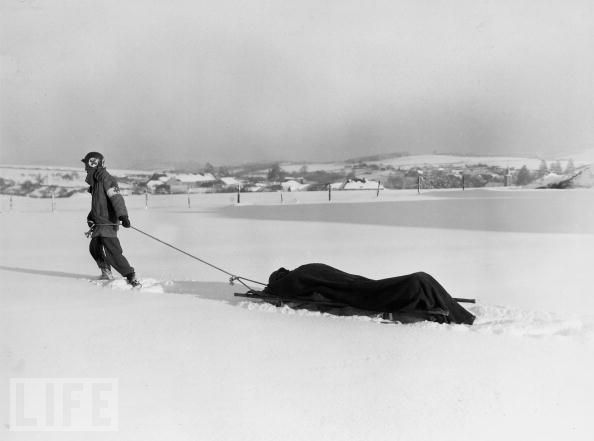
Medic Transports Wounded Soldier

Medic Philip Hahn of the Medical Detachment, 13th Field Artillery observation recalled an extraordinary situation in which his German cousin in a German field artillery position observed an American army aid station near Walheim, Germany:

The last towns we were in before the Bulge were small towns near Aachen. One was Walheim. After the war I visited my cousin who was a Lt. In the German Field Artillery. In looking over his records I saw the name of Walheim. He said that he had the crossroads zeroed in… He knew exactly what farmhouse we had for an aid-station because of the Red-Cross hanging from a window and that there were probably German civilians living there.

There were many exceptions to the above incident. Peter Couvillion served as an evacuation Jeep driver with the 9th Armored Division in Luxembourg, and recalled one of these exceptions:

On the second day (of the Bulge) after all our line companies had been surrounded, we attempted to contact "C" Company. In route we encountered a battle line of Germans. They did not shoot at us. On this mission we evacuated 16 wounded and left the slightly wounded behind… Early that morning my assistant and I contacted our "B" Company. We found the Company Medic. Leading us to where he had some wounded, a sniper shot both the Company Medic and my assistant. Both died before I could get to them. Men from the platoon found the sniper and shot him.

During the early days of the Bulge

During the early days of the Bulge when German mechanized units broke through American lines at a number of place, some medical units were captured and sent into Germany as prisoners. Emil Keith Natalle of the 326th Airborne Medical Company of the 101st Airborne Division's Combat Surgical Hospital, was located at the Sprimont crossroads, southwest of Bastogne on December 19, 1944. On this "Day 4" of the Bulge and again during the night, the area was attacked by troops of the 116th Panzer Grenadiers. A number of medical vehicles carrying wounded were set afire:

Blood curdling screams were heard coming from the burning vehicles... The German officer told Capt. Van Gorder to select a soldier and go with one German soldier to the burning vehicles and try to rescue the trapped men… The German soldier (and Natalle) could not get closer than 50 yards from the blazing vehicles. Both soldiers returned to the officers…(Later this writer was assigned to drive one of the 2½ ton, 4x4 trucks carrying wounded. So with a German soldier beside me we pulled away from the site of capture, headed toward Germany and fearful of what lay ahead… It would take 12 days before some of us arrived at our first German prisoner of war camp - Stalag IV-B near Hulhberg.

10 January, 2012

10 January 1945

V-MAIL

438th AAA AW BN
APO 230 % Postmaster, N.Y.
10 January, 1945        1110

Wilma, darling –

I guess I’m writing more V-mails than either you or I like – but at the present time, it just can’t be helped, dear. I’d rather write one of these and make sure it gets out than to take a chance on a regular letter which I don’t think I could finish. I’m writing this – as I did yesterday – in anything but a comfortable or leisurely set-up, sweetheart.

The snowing has finally stopped – but I’ll be damned if it’s cleared up yet. Just gray skies, cold wind and low clouds. This has been a mean month so far. Last evening I went over to visit Baker Battery and got tied up – and didn’t return until 0045 this morning. So I’m a little bit tired this a.m. – but there’s lots to do.

No mail for a couple of days but maybe today. No shower or bath now for about 3 weeks and believe – that’s getting to be annoying – but again – not a damn thing to do about it. Enough about our troubles, darling. Aside from everything else, I’m feeling fine, eating well and as if you didn’t know – missing you more and more. Will try to write tomorrow, sweetheart. For now, so long, love to the folks and

My deepest love
Greg

Route of the Question Mark


[CLICK TO ENLARGE]

(A) Aisne to (B) Chêne Al Pierre (8 miles) to (C) Verleumont
(11 miles) 2 January - 10 January 1944

January 10...Chene al Pierre. All the snow and cold weather were concentrated in the two weeks that we were here, and we really hit rock bottom. We stayed as close to our stoves as possible, but we froze our feet anyway. The Battery split up, and part of it went to Verleumont, ten miles away...lived in barns and stables and were isolated by a blizzard from the rest of us. We received our sleeping bags here, and not a moment too soon. The Communications section nearly went insane trying to keep thirty miles of wire in working condition.


On a Wrecked Half-Track Stringing Communication Wires

* TIDBIT *

about Medics in the Bulge
Part 1

The following information is excerpted from a page posted by the Belgium-based "Center of Research and Information about the Battle of the Ardennes" (C.R.I.B.A.)", which was referenced in the February, 2006 issue of "The Bulge Bugle", Volume XXV, Number 1, containing "Medics in the Bulge," by Ralph Storm.

Usually the most difficult part of medical evacuation was in getting patients from the front line to aid stations. Keith Winston of the 100th Division medics in his V-Mail Letters of a Combat Medic wrote how it was done under ideal conditions:

A boy gets hurt on the line. Within a minute or less a telephone message is sent back to our forward aid station, a distance of 300 to 1000 yards from the front, where a Sergeant and four litter bearers are always on hand. They rush right up to the line with a litter.

During this time, the company aid man is administrating first aid on the spot... usually consisting of stopping the bleeding with sulfanilamide powder externally, bandaging and giving wound pills internally. By that time, another litter team is there and carries the casualty to the nearest point where a jeep can travel... anywhere from 25 to 300 yards, depending on conditions.

The boy is then rushed to the aid station, one to three miles behind the line. Here the physician removes the first aid bandage, makes a proper diagnosis, applies a more permanent bandage, administers blood plasma if needed, and in severe case, gives morphine... Next the boy is rushed by ambulance to a clearing station farther to the rear. Here he may be given an emergency operation. Then the casualty is taken by ambulance to an evacuation hospital further back where first class attention is administered.

One issue concerning seriously wounded soldiers was whether some should be sent back to the States on hospital ships. General George Patton had a somewhat unsympathetic answer to this question:


If you have two wounded soldiers, one with a gunshot wound of the lung, and another with an arm or leg blown off, you save the son-of-the-bitch with the lung wound and let the goddamn son-of-the-bitch with an amputee arm or leg go to hell. He is no goddamn use to us any more.

The Aid Station


Temporary Aid Station, Belgium, January 1945

The aid stations had no beds and were equipped only with bare essentials. After patients were diagnosed and treated, information was jotted down on a card which was attached to a button hole in the patient's coat.

Litter carrying was hard, exhausting work and often only two bearers were on hand. Glenn Ghrist Jr., of 32nd Battalion, 3rd Armored Division Medics recalled carrying wounded GIs near Sart, Belgium:

It was cold as hell… some of us survived the cold. A Captain Duffy and I volunteered to get some wounded soldiers from a field which was under artillery fire, etc. We had to wade a small river or creek to get these two soldiers and bring them to the Jeep. We carried them on our shoulders, sometimes crawling, sometimes running to get the hell out of there.

Glenn had been wounded earlier at the Falaise Gap in France, and was wounded again at Sart, Belgium. Glenn, on occasion, rode in a tank in which the tankers called him "Doc".

It was not unusual for battalion surgeons to sometimes act as litter bearers. Keith Winston wrote of his unit's being short of litter bearers in emergencies:

If an emergency arises your position means nothing. If it calls for five liter teams immediately, Doc and I will go up and haul. He and I were doing it one day with no facilities at all.

Gilbert Lueck of the 26th Infantry division medics recalled a night when he and the battalion commander carried out a badly wounded lieutenant. It was after darkness had fallen, and Gil was bedded down in his slit trench several hundred yards behind the front when he heard a Jeep pull up nearby and a familiar voice call out, "Medic, medic!" Gil had heard that voice before. It was the battalion commander and Gil had gotten into a heated argument with him once in the states. Gil recalled how the CO had chewed him out. Gil was thirty-one when he was drafted and not easily intimidated by higher ranks. Gil stood up and called out, "Here sir!" The Colonel described the situation as they climbed into his Jeep. They drove to a nearby village and eventually found the injured lieutenant lying next to a manure pile. They placed their casualty on the Jeep and drove him to the aid station. For Gil it was a routine event until several weeks later he was summoned to the battalion headquarters where he was awarded a Bronze star.

09 January, 2012

09 January 1945

V-MAIL

438th AAA AW BN
APO 230 % Postmaster, N.Y.
9 January, 1945        1100

Hello Sweetheart –

I know you worry when you don’t hear so I’m trying my darndest to get some kind of letter out to you each day, dear – but sometimes it’s difficult – not always because of the time element, but more often now because of the conditions, environment, weather – need I go on?

It snowed like all get out yesterday. As a matter of fact, counting today – it’s the third day of snow and it’s more than I’ve seen for 2 winters. Last winter in England – there was practically no snow at all, and the winter before that we were South on maneuvers. It looks as if we’ll get our fill of it this winter though. But we’re doing all right and heading back steadily, if slowly, in the right direction – so don’t be discouraged, darling, and don’t worry, because I’m taking good care of myself.

All for now, sweetheart, except to remind you that – snow, rain and ice – make no difference. I still love only you. My love to the folks – and so long

All my love, dear
Greg

* TIDBIT *

about the Continuing Counter-Offensive

From "U.S. Army in WWII European Theater of Operations: The Last Offensive" by Charles B. MacDonald for the Department of the Army's Office of the Chief of Military History, page 31, published in 1973 in Washington, D.C. comes this excerpt:

Near the end of the first week, on 8 January, Hitler at last authorized a withdrawal, not all the way back to a line anchored on Houffalize as General von Manteuffel had urged but only out of the extreme tip of the bulge to a line anchored on a great eastward loop of the Ourthe River some five miles west of Houffalize. Because of the point at which Hitler drew the withdrawal line, only a few troops of the Sixth Panzer Army, those on the extreme west wing near La Roche, were involved. Those authorized to withdraw were mainly contingents of the Fifth Panzer Army facing the British and the U.S. VIII Corps west of Bastogne.

While the units of the Sixth Panzer Army were to continue to hold, Dietrich's headquarters was to pull out, gradually relinquishing control to the Fifth Panzer Army. Thereupon, the two SS panzer corps headquarters and four SS panzer divisions that originally had belonged to the Sixth Panzer Army were to join Dietrich's headquarters in the rear near St. Vith, there to form a reserve to guard against attacks near the base of the bulge. This was, in effect, tacit admission - Hitler's first - that the Ardennes counteroffensive had failed utterly.

Reflecting the withdrawal, resistance on the right wing of the VII Corps gradually slackened. The fight was as dogged as ever on the other wing, where in deference to marshy ground and an impoverished roadnet leading to the final objectives on the southeastern slopes of the Plateau des Tailles, the 83d Division on 9 January 1945 assumed the assault role on the left wing of the VII Corps. It took the infantry two days to break into and clear a village south of the La Roche-Salmchâteau highway and another day to beat off counterattacks. Not until forcibly rooted out would the Germans budge from any position.

The 84th Infantry Division was given the right half of the zone. As far as the La Roche Road, the 333rd Infantry had advanced with relative ease. Once beyond the road, it ran into much more trouble. In Les Tailles and at the edge of the woods to the south, an estimated enemy battalion was dug in. On the other side of the Houffalize Road, an estimated reinforced company was holding Petites Tailles. The 2nd Battalion went out from the La Roche Road to Les Tailles, the 1st Battalion to Petites Tailles. The experiences of both were significantly similar.


84th Infantry Medics carry 333rd wounded,
some on litters over the hood

At the same time, the 82d Airborne Division had the job of protecting the left flank of the VII Corps. To do this, the airborne division was to press forward to the line of the Salm River. Assisted by an attached separate regiment, the 517th Parachute Infantry, the airborne division had jumped off along with the VII Corps on 3 January. Like the armored divisions, the paratroopers and glidermen had met resistance immediately from the weather, the terrain, and, to a lesser extent, the enemy. Close alongside the boundary with the VII Corps, the 517th Parachute Infantry had made only limited progress until it turned abruptly on 7 January to take the enemy in flank. The next day the paratroopers drove all Germans before them east of the Salm and sent patrols to range as far as two miles beyond the river. On the 9th they established a small bridgehead across the Salm to be used as a stepping stone when the offensive turned in the direction of St. Vith.

08 January, 2012

08 January 1945

438th AAA AW BN
APO 230 % Postmaster, N.Y.
8 January, 1945        1300

My own darling –

I got your letter of 26 December late yesterday afternoon and I read it over and over again. You were blue, you were sad, you were romantic, sentimental. You were sweet, poignant; you were a woman. I always felt you loved me, sweetheart, before I left and more so after I came overseas. But never before have you expressed yourself so clearly, so warmly, so affectionately. You put me at a loss for words to adequately describe to you my feelings on reading that letter. I thought I had powers of expression, darling, but I don’t see how I could possibly do as well as you.

Sweetheart – you ask me to put aside any hesitation I might have about writing you a sentimental letter. Do you catch any sentiment in my letters at all or do I hide it too well? Every hour, every day – I’m filled with sentiment, and thought and love for you. It becomes so aggravating I lose my civility. I want to write you, to tell you all the things that run through my mind – and I stop; I become matter of fact, tell you some of my activities and let it go at that. I tell myself then what a good soldier I am.

I suppose I am, but it hurt me to read your letter asking me to tell you I love you, I miss you. It makes me feel I haven’t been a very good fiancé – when all the while my longing for you and my heartache that we must be apart are enough to drive me mad at times, enough to make me want to do almost anything to get out of here and back to you where I belong. Each hour, each day is interminable for me away from you; I’m so jealous of time I become morbid over it. I see a cloudy sky and realize the war is thus delayed another day and I’m miserable. I’m not the happy-go-lucky fellow I once was, darling, not by a long shot. I can’t be – although my nature is such. I see you in everything I do and seeing you I want you and not having you is frustrating to the point of agony. Lonely? How can a fellow become lonely with thousands of soldiers about him, with things popping around him – and I’m lonely, so terribly lonesome at times, so more lonesome than I’ve ever been before, darling – lonesome for you and your love and warmth and affection and intimacy; lonesome for you and you alone darling. I want you, I want us to be together, alone as man and wife, living as we should be living, dear – not in this strange way, waiting anxiously for letters, thinking into the dimming past about the few precious months we had together. I can sit by the hour and think about those times, about how I came to love you, how I was fighting against the time I had to leave and angry with fate because I hadn’t quite enough time to ask you to be my fiancée. I knew then how I felt, but I wouldn’t let myself, you or anyone else say or think I had tied you down at the last moment. I wanted time to dignify our engagement, and it did. But not before I worried about it, wondered what would happen, asked myself if I were going to lose you after having found you – the girl I wanted as my wife. Those were trying months, too, sweetheart. And then when we did become engaged – it was chagrin all over again at my not being able to see you, feel you, kiss you and tell you the things I felt in my heart and only partially said because I knew that we could take it better that way, that we could learn to miss each other more easily.

And what do you suppose combat has been like? You can read a lot about it in the papers – but you can’t find out what I’ve felt and experienced – not in the horrors of war, but in what goes thru a fellow’s mind when he’s in love and wants to get back to the one he loves – whole and sound as he left –

Sweetheart – believe me when I write that I believe the way I’ve written in the past is best for both of us. You must know in a hundred different ways that no one in this world means as much to me as you, that I love you as I’ve loved no one before, that my one goal is to marry you and make you happier than you’ve ever been before in your life. Have faith, darling, and patience – and when the time comes we’ll be the happiest, luckiest, most in-love couple in the world. Remember ever and always – that I love you deeply, sincerely, faithfully – and that now and always I’m

Completely yours,
Greg

* TIDBIT *

about the "Blunted Spear"

The following article, titled "Blunted Spear", comes from TIME magazine, January 8, 1945, Vol. XLV No. 2, giving a review of the Bulge so far. The photos are from various places on the internet.

The battlefield east of Celles was a white silence, darkly blotched with corpses and wreckage. At Celles, three miles short of the Meuse River, the German spearhead which had reached 50 miles into Belgium was blunted and turned back.

CLICK TO ENLARGE PICTURES

2nd Panzer Division near Celles, Belgium - December 1944

When Field Marshal Gerd von Rundstedt's advanced forces reached Celles they were jumped by First Army tanks, artillery and infantry, aided by U.S. and British planes. The enemy lost 63 tanks, 49 guns, 177 vehicles, 1,200 prisoners, uncounted dead. Then, in a wild two-day battle the German remnants were driven back to Rochefort.

Rocks in the Stream. The German drive had already been slowed down by the heroic stand of the 101st Airborne at Bastogne (see below), which confined Rundstedt's columns to secondary roads north and south of the town. The 82nd Airborne had put up a fierce defense around Stavelot, the 7th Armored between Saint-Vith and Vielsalm, the 1st Infantry at the north shoulder of the salient below Monschau, and the 4th Infantry at the south shoulder, around Echternach. The two infantry outfits had prevented Rundstedt from widening the salient's base. They were pegs that did not pull out.

In the path of the Germans, U.S. troops died with knives clenched in their fists, having run out of ammunition. Others, bypassed and trapped, lived for days on raw potatoes. The situation looked bad when the two German prongs merged in one bulge. It seemed the enemy might reach the great sweep of the Meuse from Liège to Sedan,dig in behind the river.

In the early days of the attack, General Eisenhower had hustled to a headquarters at Verdun, conferred with his top generals. In 15 minutes he had appraised the scope and probable aims of the push, taken his decisions, issued his orders. First Army reserves bore down from the north, compressed the salient's right flank, recaptured Grandmenil and Manhay. On the south, General Patton's armor blasted a corridor to Bastogne, pushed on to the north and then west to encircle the German tip south of Saint-Hubert. Patton also broadened his attacking front all the way east to Echternach.


Manhay Crossroads

Shrinking Salient. Last week Patton's wedge was only 13 miles from the First Army dents in the north. The German position was something like that in the Falaise-Argentan pincers of last summer. Could the Germans get out? It was well to remember that last summer, when the Wehrmacht was less ably commanded than it is now, the Germans who had seemed hopelessly bottled in the Falaise trap were able to extricate five divisions of armor almost intact. If Rundstedt was content with the delay and damage already wrought against his foes in the west, he might be able to pull back to the West Wall without serious loss.

Up to this week, however, he gave no sign of preparing such a move. His salient was contracting, but it was shrinking around a hard armored shell—in which he might be regrouping for another thrust at Liège, main Allied rear base for the Aachen-Cologne sector. The first heavy German blow in four days was an assault by three divisions on the Bastogne corridor.

07 January, 2012

07 January 1945

438th AAA AW BN
APO 230 % Postmaster, N.Y.
7 January, 1945        1300

Wilma, darling –

Well – last night was Saturday and so this must be Sunday afternoon but somehow it doesn’t seem quite like it. I don’t know exactly why. It has been persistently cloudy, foggy and raw outside and that hasn’t helped us one bit, as you can easily imagine. Everything seems stagnant – just as if it were the middle of the winter, and my gosh! – it really is, isn’t it? There are now flurries again today – and I suppose we just can’t expect any decent weather until the Spring.

Last night was extremely dull and all of us just sat around and talked. I played three or four games of cribbage with one of the boys – and that was about all. The night, as well, was quiet. This morning the sick-call was quiet, too, but I expect some patients in – a little later this afternoon.

Say, before I forget it, will you do me a favor darling? Eleanor’s Birthday is February 14th and I can’t get her anything from here, of course. If you could send her some chocolates in my name and also get her some gift of some sort, I’d appreciate it a whole lot. I had a blank check made out, signed – and then I tore it up because it’s just not a good idea to send checks like that in a letter. I’d rather wait until you tell me what you spent and then mail you a check for the correct amount. Get her anything you think she wants and have it signed ‘Happy Birthday, Harold’; ditto for the chocolates. I’ll thank you now, dear, for the trouble.

And that reminds me – how did we make out on a gift for Stan and Betty? Did you finally get one and if you did I want to know my share. Include the amount on what you spent on Eleanor’s gift and I’ll send you a check for the total.

I was so glad to read you had received the perfume – and so close to the correct time. It was pure hypothesis as regards time – when I had it mailed – and I hoped you liked it. When we came thru France we traveled too swiftly to buy anything, and the day I got to Paris – buying anything was out of the question. But I did manage to get to Chalerois – in Belgium and get just about the last bottle in a parfumerie. It seems that every G-I over here had about the same idea. I have since looked several times – but what they have now has been diluted with water and the popular brands just don’t exist anymore. You might write me the names of a few of the desirable ones, though – and I can keep my eyes open.

The paperweight and calendar – were just free riders, dear. I had them – the calendar since way back in France – and I just thought I’d send them along. The eagle I found on the desk of a luxurious office in a town when we first hit Germany. It was the office of the Nazi Party in town and the paperweight was evidently some trophy or prize given to one of the occupants of the office. I liked it – so took it. Anyway – I’m glad you liked the perfume and that it wasn’t broken. You know – you must have quite a collection of junk that I’ve sent you ever since I hit England. What are you doing with it all, dear? And by the way, how’s the clock running – if at all? I’ve got another trophy to send you – a dagger, no less – but darling it’s significance is only as a souvenir. I’ve had it for some time but I didn’t know whether or not I could mail it. I think it is allowed now. It’s beautifully steeled, has a scabbard, is engraved with “Alles für Deutschland” – on the blade and of course has the Nazi seal on the handle. I’ll have it packed in the next few days and send it out. After the war, sweetheart, we’ll have to have one room for trophies – or junk – as you may see fit to call it.

Well, that’s the story for now, dear. I’m going over to see if there was any mail today. It’s been 4 days now, I believe, and I could do with a couple of nice letters from you, believe me. Hope you’re having a nice day now back home and I sure would give a lot to be sitting in your living room now, with you by my side – just as we used to do. But surer than shooting – I’ll be doing that again and we’ll be happy. Love to the folks, sweetheart. So long for awhile and

All my deepest love,
Greg

* TIDBIT *

about Two Battalions Heading for Houffalize

Here is more of Sgt Theodore DRAPER's story of the 84th, with photos from various places on the internet:

2nd Battalion, 333rd Infantry

The turning point of the entire action probably came on 7 January 1945, not where we had to fight the hardest but where progress was still relatively easy. That day, the 2nd Battalion, 333rd Infantry, was sent out to capture the vital crossroads where the La Roche Road and the Houffalize Road meet. The weather was miserable. A snowstorm whipped up during the attack. Nevertheless, by 0930, the crossroads were ours. Prisoners, frozen, hungry, and disorganized, were picked up in small, wandering groups. They said they were surprised again. An attack in such harsh weather was completely unexpected. Our interrogators heard that story almost every day. As soon as we captured the crossroads, the enemy was deprived of the only two first-rate roads to the east, the La Roche Road and the Houffalize Road.

Partly because German resistance above the La Roche Road on our right flank was so much stronger than on our left, we were able to cut the road first on the extreme left of our zone at the crossroads. As we gained full control of the road, we continued to move from left to right. Next, one of our task forces came down from Amonines to Dochamps and from Dochamps we launched the attack on one of the enemy's positions, Samree. The trip from Amonines to Dochamps was the same, old story. The road, though the best in the sector, was so icy and narrow that the tanks were held up repeatedly.

CLICK TO ENLARGE PICTURES

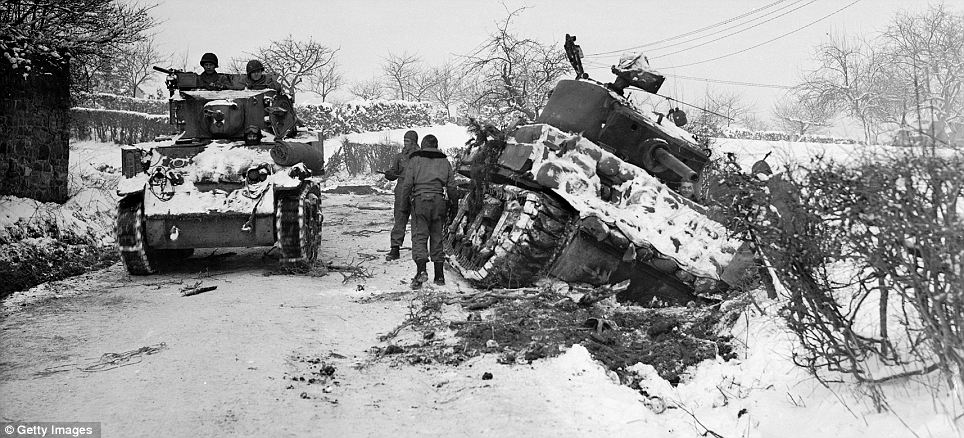
US Tanks near Amonines, Belgium - January 1945

Road blocks, which took about two hours each to reduce on the average, some small-arms fire but this time very little artillery, represented the enemy's main effort to hold us up. Mine fields and trees felled across the road by detonating TNT charges, antitank guns and tanks, were effective sources of enemy resistance. On 7 January, we were able to move into Dochamps.


2nd Armored Division entering Dochamps, Belgium
January, 1945


Dochamps, Belgium, Today

One incident was symbolic. After we had spread out in the village, a German tank with 60-80 infantrymen suddenly pulled out from behind the church and made for Samree. Our tank destroyers could not fire a shot because their turrets were frozen, striking example of weather conditions which lessened the effectiveness of our mechanized equipment and threw the main burden of attack and defense on our infantry. Samree was seemingly impregnable. It was perched on an 1,800-foot hill.


Amonines to Dochamps in Valleys
(A) Samree on a hill

First we had to take two other hills, northeast and northwest of it. Our troops had to move through 1,500 yards of rolling ground in knee-deep snow. The enemy had perfect observation every inch of the way. To tell the truth, it was hard to see how we could make it.

1st Battalion, 334th Infantry

The battle of La Roche is a good example of the battle of supply and the battle of stamina which every Battle in the Bulge was. The roads to La Roche were particulary bad, the hills particulary high and the woods particulary dense. A few tanks and trucks turned the snow on the roads into ice and the trouble started. The Doughboys depended more than ever on the Engineer and Artillerymen. The main attack was launched from Devantave by the 1st Battalion, 334th Infantry. The first objective was Marcouray. Over a hundred guns softened up the village for five minutes.


Marcouray, Belgium Today

Then, at 1500, 7 January 1945, the infantry jumped off. The ground was rocky and steep. It was snowing again. Thirty minutes later, all German resistance in Marcouray was overrun. We found that the enemy positions were carefully prepared. Snow was a natural camouflage. Fortunately, we were achieving tactical surprises and much of the preparation was wasted. As prisoner after prisoner told us, the weather and terrain were so bad that our infantry was simply not expected. That is one compensation for "impossible" conditions - they are apt to lead the enemy to drop his guard. The enemy's surprise at Marcouray was shown by the equipment he was forced to leave behind. We picked up 36 vehicles: eight half-track, two command cars, six U.S. jeeps, six civilian type cars, five six-wheeled reconnaissance vehicles, five U.S. tanks, two German 1½-ton trucks.

06 January, 2012

06 January 1945

438th AAA AW BN
APO 230 % Postmaster, N.Y.
6 January, 1945       1330

Dearest darling Wilma –

I’ve had a kind of busy day today and this has been my first opportunity to sit down and try to concentrate for a few minutes anyway. No mail yesterday or today because the A.P.O. is moving, I guess.

Last night was quiet. Bruce and I challenged the Colonel and Hi Morley to a 3 rubber game of Bridge and we had our ears pinned back losing 2 out of 3 of the rubbers. But it was fun and time-consuming. We’re not playing so much now because our present set-up has us spread out quite a bit and we don’t care to walk around between spots very much at night. Coming back last night we were challenged at least ten times. It’s very essential to know the password these days.

I like reading your ideas about love in one of the letters I received from you day before yesterday. You say that seeing me happy and content will make you so, too. Since I feel the same way, sweetheart – it ought to be ideal. You ask me a question that’s very difficult to answer, darling, the one about my previous ‘love’ for any other girl. Yes I am older than you and presumably more experienced therefore. The ‘other girl’ – I don’t recall at all so I can’t answer that. I feel certain I didn’t love her. I don’t know how to describe exactly how I felt about Alice. It’s a long time since she was fresh in my mind, too. To be perfectly frank, dear, I thought I loved her towards the end of the time I was seeing her and I was no youngster then. To be true – I was attracted to her physically more than anything else – and that plus the fact that it was so convenient to see her – made her seem indispensable at that time. But had I truly loved her – I believe I would have married her, religion or not – and the fact that after 4 years I was able to stop seeing her and see the light, makes me think that it couldn’t have been love. Love is something I certainly can’t describe. To me it’s like a result, the effect rather than the cause. How did I know I loved you? I don’t know the answer dear; I just felt I did. I liked you the very first time I went out with you – and not only because we had fun that night. You appeared to me immediately as the girl I’d always wanted and never met before. I felt I loved you not long afterwards for the way you reacted to me, the way you laughed, carried yourself; for your ideas on life, for your maturity despite your age. I like to dance with you, talk with you, sit beside you, kiss you. That’s loving someone. I’m sure, sweetheart. I’ve never felt differently since – despite our separation – and I know I won’t change.

I was a little surprised at your statement that Mother B thought I was not quite warm enough – especially when I address your folks as “Dear Folks”. To me, dear, that’s just about the warmest expression ever – and it’s what I’ve always used when writing my own folks. But I think in the long run, darling, that Mother B will know I do feel warm to your folks and it’s more than that.

It’s getting late, dear and I’ll have to run along and get some supper. Hope to hear from you tomorrow. For now, love to the folks – and so long.

All my eternal love
Greg

* TIDBIT *

about the Counter-Offensive Continues

Here is more of Sgt Theodore DRAPER's story of the 84th:

By the time we took Devantave, it was clear that the original plan which gave the infantry a supporting role was not working out. The terrain and the weather were against it and they won. The victory of the elements gave the Infantry the main job. The Ardennes neither lacks roads nor is rich in roads. A British source has estimated that 13 separate first-class roads cross the Ardennes from Germany to France. There are perhaps three secondary roads for every first-class one and numerous trails. But so many pass through long stretches of woods, so many teeter on the edge of cliffs and wind up and down and around the inescapable hills. In May, too, the possibilities of resistance in the Ardennes would be immense.

In January, in snow that keeps piling up from the ankle to the knee, from the knee to the waist, only a little effort is necessary to turn possibilities into realities. All vehicles have to stick to roads to get anywhere, only more often than not they cannot stick to roads because they are constantly sliding off. The next best thing is to proceed slowly and carefully but then your vehicles may miss the jump-off by hours and the infantry has gone off alone. Is it curious that a terrain that is considered too tough for a tank is never considered too tough for a Doughboy? As a result of the problems which arose in the first four days for the armor, after Devantave was taken, more clearly defined zones for the armor and the infantry began to emerge.

From Devantave, the 2nd Armored Division, with the 335th Infantry still attached, veered off more sharply to the southeast to get to Samree through Dochamps, while the 84th Infantry Division assumed responsability for the drive southward to La Roche and for the La Roche Road as far as Samree. One thing stood out again. When nothing else moved, the Doughboys moved and they moved long and often. And what was it like for them? It took a good two hours to get through the frozen crust of earth. It took two or three hours more to get down as far as three feet. Not only was digging a foxhole a job in which a whole day's energies could be consumed, but it was practically impossible to dig a really good foxhole at least five feet deep.


GIs digging hasty foxholes near Berisment.
For the soldier in the foreground it was too late.

The weather continued to get colder and colder until it went well below freezing and stayed there. This meant there was only one thing worse than not sleeping - and that was sleeping. The quickest way to freeze is to lie still. Men went to sleep in overcoats - when they had them - and woke up encased in icy boards. It was practically impossible to bring up supplies and rations in anything but half-tracks. Water congealed in canteens. Frostbite was as dangerous as all the Krauts and their guns put together. The Doughboys who went into Devantave fought 96 hours without a break and they were not through by a long shot. We took Consy the way we took most of the strong points - by going around it.


Two sharpshooters of G Company, 290 Infantry Regiment,
US 75th Infantry Division provide cover near Devantave

When we took Devantave on 6 January 1945, we outflanked Consy on the left. Then we sent two battalions into the woods west of Consy and the enemy was squezzed out in the middle. He did not choose to hold even this commanding position at Consy at all cost. By 7 January 1945, Consy was virtually cleaned out though the woods on the right flank were not completely safe for another two days.


Road to Devantave Today