06 July, 2011

06 July, 1944

438th AAA AW BN
APO 403 % Postmaster, N.Y.
France
6 July, 1944          1015

Dearest sweetheart –

Another day, another letter. Again I believe I have been able to write 3 letters in a row without resorting to V-mail. I much prefer this because I don’t feel cramped. I got another letter from you last night – written the 20th of June at the Clark’s. If I can get one a day like that, dear, I’ll be happy. Getting 14 letters from me in 2 days should impress you with at least one thing, if nothing more, – and that is that I’m writing to you. It’s too bad they have to come bunched like that though.

Well I’m glad my check arrived, sweetheart, and I hope you didn’t have to go to too much extra expense to get what you did. And I hope the gifts were enjoyed. It is absolutely impossible to think in terms of things to buy in France. It was bad enough in England – where a shortage existed because 1) lack of manufacture or import and 2) American troops having bought up everything after being in England for two years. In France – the Germans bought up everything usable a long time ago and whatever appears now is black market and worthless. Incidentally everything is priced in the hundreds or thousands of francs and that seems to be the effect of the tremendous amount of francs the Germans printed. They flooded France with it and as a result – our money is just as cheap. As a matter of fact – a storekeeper would much rather have a pack of cigarettes or some GI rations – than the francs – because he can’t buy anything with the latter, anyway.

I had occasion to be in Cherbourg and of course I can’t tell you much about the place for many reasons. As is usual with my outfit – or at least with me – whenever we get anywhere – I manage to see about every part of the place – and so with France, so far. I’ve run into a couple of fellows I knew slightly at Edwards and I don’t remember if I mentioned it to you already – but I did see some evidence of an outfit’s being here that you mentioned in one of your letters – the brother of a girlfriend of yours from Portland, I believe, is in that outfit. Seems to me I may have told you this already – but it’s easy to forget things here.

CLICK ON IMAGES TO ENLARGE

Cherbourg (Manche) Postcard
Le Quai Alexander III


Cherbourg (Manche) Postcard - Front and Back
The Beach - Before the Invasion!

8 July 1944
Hello Dear! I can't write when I was here -
But I guess I can tell you -
It didn't look like this and I didn't go swimming.
Love, G.

And sometime after the invasion...


Well, darling, I’m proud of you. Eighty-eight percent is a high mark in any type of exam. What comes now? Are you through your training period, do you wear a uniform – and what else?

I was glad to read that Betty and Les were finally married. Those two really “sweated” it out. It’s going to be mighty difficult for her when he goes overseas, though – and that he will – I feel pretty certain – particularly if he’s in the infantry. I’m sorry to read though that she didn’t graduate. She’ll always regret that fact, especially later in life. Somehow or other I feel that was Les’s fault and had he insisted more strongly – she might have stuck it out.

Sweetheart – that’s all for now. It sure is great hearing from you again and I’m glad the reverse is true. I love you, dear – and hearing from you is my only satisfaction these days – but there’ll come a day! Love to the folks – and

All my love is yours, dear
Greg

La Presse Cherbourgeoise, 5 July 1944, Number 3
"First Newspaper of Liberated France"

CLICK ON IMAGES TO ENLARGE


05 July, 2011

05 July, 1944

438th AAA AW BN
APO 403 % Postmaster, N.Y.
France
5 July, 1944         1000

Dearest sweetheart –

I received a letter from you last evening written by you on the 19th of June and mailed on the 20th. Although that made it two weeks old, it sure seemed up to date to me, darling; and as I exclaimed, jokingly to the boys around me when I finished reading it: “She still loved me as recently as the 19th of June!” But it really was good to hear from you and to read that some of my mail was beginning to reach you, dear.

No – I haven’t heard from Stan I can say – literally – for months and I certainly am thoroughly disappointed in him. He never did let me know if he received the lighter – by the way. As for his having ‘found’ a girl – I don’t know. Stan gets strong likes and dislikes – and how long they last depends very often on how long the person is enchanted by his line. Anyway – with the man shortage in Washington – he must be having one heluva time for himself. Apparently he has no self-consciousness whatsoever about being in civilian clothes. Boy – it would do some of those boys a lot of good to get out here and live close to the ground for a little while; to perspire freely after digging a fox-hole and not be able to change their clothes; to find their shirt-collar getting black and grimy – and just go on wearing it; to go 3 or 4 nights in a row without removing their shoes and stockings; to just ache for a bath or shower and finally – regardless of the weather or the water – to bathe by repeatedly filling a helmet with cold water and sponging, sponging and sponging. It would do them a lot of good, I repeat, and might make them appreciate the simple convenience of life a bit more – let alone the luxuries of night clubs, dinner and dancing. I never before resented anyone’s being out of this thing, but you can’t help but build that feeling up in you after awhile. Perhaps it’s because up to France – I wasn’t really in the war, dear – just marking time – and believe me – the difference defies description.

Excuse me, darling, I didn’t mean to get off on that tangent. Incidentally when we take a bath as described above – we say we wash down as far as possible, we wash up as far as possible – but we don’t quite wash possible. Excuse that, too. I liked the enclosed prayer, dear. Thanks for sending it and thank Mary, too. The thought is excellent! I forget so often these days that I am a physician. The fact is the amount of medical work I have to do is practically nihil – due to our setup, and there’s no doubt that if I ever want to do surgery in the future – I’ll have to have more training. But I’m not worrying too much about that now, sweetheart. What I want most of all is to return to you in good health and to find everything and everyone just the way I last saw it. I’ll worry about other things later. I feel certain that one way or another I’ll be able to provide for us in respectable style.

I’m glad you’re spending time with my folks, dear – and I hope you get a chance to do some swimming in Winthrop – this summer. By the way – how is your Mother feeling these days, dear? Your mention of bridge seems so distant. It seems like ages since I last played and I guess I’ll have to learn all over again – but that too doesn’t worry me very much darling. All I want is to make you my wife and the sooner I do, the better I’ll like it.

The enclosed Stars and Stripes is the first issue – as you can see – in France. There were very few put out – but I managed to get one. If you can, dear, save it – for sentimental reasons.

Well – that’s all for now, dearest. I’ll close now – but remember, sweetheart – I love you deeply and miss you more than I can say – Love to the folks – and

All my love for always
Greg

First "Continental" Edition of The Stars & Stripes Vol. 1 No. 1
Pages 1 (top and bottom) and 2 (top and bottom)

CLICK ON IMAGES TO ENLARGE


04 July, 2011

04 July, 1944

438th AAA AW BN
APO 403 % Postmaster, N.Y.
France
4 July, 1944 0945

My darling –

On this holiday – I wonder where you are and what you’re doing. Whatever it is – I hope you’re enjoying yourself, dear. This is one of the few days since arriving in France that the date has had any significance for us. The fact is – all days are noisy. I can think of the times when I jumped at the noise of a two-inch firecracker – and now – well the less said the better. Anyway – we’ll try to have a sane and safe 4th. The French – you remember – celebrate the 14th of July, their Bastille Day.

Another date that I remembered was yesterday’s. On July 3, 1942 I reported for active duty. Boy! Was I green! After the war, sweetheart, I’ll give you my impressions of my first few days in the Army. It was really funny. I didn’t know then how long I’d be in the service – but I sure am glad those two years are behind me. By any sort of reasoning or prognostication – more is behind me than ahead of me, and that thought, darling is very soothing.

Let’s see – this is Tuesday, I think, and if so – it must have been difficult to make a long week-end out of the Holiday, although I suppose some people were able to take Monday off. Last night at supper we got to thinking and talking about the night before the 4th in the old days – and each fellow had a slightly different version of what it was like in his city; represented were Buffalo, York Pa, Brooklyn, Portland Me, Chicago, Phila, Davenport Iowa, and Portsmouth N.H. I took care of Boston. You can see that an interesting discussion took place. All agreed however that we’d probably awaken today with clearer heads – and we did.

Awakening in the morning these days, darling, is different than it ever was before. For my own part, I feel very humble and thankful for another day, and although I don’t actually say a prayer in the morning in so many words – I do so in my mind. Nights can be hell around here for half a dozen reasons that I won’t go into – and as I said, on awakening, I – at least – feel thankful. A fellow gets to lean heavily on a prayer and the thought of a Protecting God out here. I feel glad that I’m not being hypocritical in this feeling, because in the past I have always felt the same – albeit more independently.

Darling – don’t misinterpret all of the above to mean that I’m under constant fire or anything like that. But we do hear guns go off in the distance, sometimes, as well as our own guns – and when you haven’t had quite enough sleep of a nite – you begin to think that every gun of the evening is trained just at you – and whether it is or it isn’t – you can be just as thankful in your mind for being alive.

I know I haven’t written like this before and I don’t expect I will very often, sweetheart, but it would be very idiotic of me not to have received some impressions of this whole thing, and I know I can transmit my impressions to you without making you unduly alarmed. I have not been in danger, dear, and I don’t think I will be. What I’ve described to you is just some of my inner thoughts and reactions on realizing that I’m in a war area.

There was no mail yesterday – but we have good reason to believe that there’ll be some today – and I’ll surely hear from you, dear. If your letters were ever dear to me before, you have no idea of what they mean to me here. They link me with you so inextricably that I forget about time and distance and by the time I’m through reading one of your letters I find myself projected back to Boston or Newton – or in fact – to wherever you happen to be writing about. It is good tonic, sweetheart!

Well, dear, I’ve got a few things to take care of. Our jeep ‘Wilma’ is always around and I see and say your name a hundred times a day. I hope you’re well, dear, and enjoying your work – although Boston must be hot these days. My love to the folks. So long for now – and

All my love
Greg

03 July, 2011

03 July, 1944

V-MAIL

438th AAA AW BN
APO 403 % Postmaster, N.Y.
France
3 July, 1944

Dearest fiancée –

You know that’s a real French word. Some of the French farmers ask me if I’m married. I say ‘no’ – of course – but follow it up immediately with the picture of ‘ma fiancée’. They all say “très jolie, très gentile, vous êtes très heureux” – and darling – I agree.

No mail for a couple of days – but in view of the situation – that’s understandable. Nothing much happening here, though, dear.

I get awful blue spells when the going seems slow – but now is the time we must be really patient, darling – and I guess I can hold out. I hope your patience is with you too, sweetheart.

Sorry – I can’t write more right now. Love to all at home, dear.

My everlasting love –
Greg

* TIDBIT *

about Congratulations and Continuing On

CLICK ON LETTER TO ENLARGE

Congratulatory Message
from the Secretary of War to Omar Bradley


From US Army in WWII: The Breakout and Pursuit comes this:

In keeping with the desire of Generals Eisenhower and Montgomery to get the American offensive to the south under way, General Bradley had lost no time in redeploying the VII Corps from Cherbourg. As the Cherbourg operation was ending on the last day of June, Bradley ordered the VII Corps headquarters to move to Carentan immediately to assume responsibility for an area on the east of the VIII Corps.

The new VII Corps sector, between the Prairies Marécageuses de Gorges and the flooded Taute River, covered the shallowest part of the Allied beachhead. Through Carentan passed the only highway linking the U.S. troops in the Cotentin with the Allied forces east of the Taute River. The area was considered the weakest and most sensitive part of the entire First Army front.

A road center and small seaport, Carentan was extremely vulnerable to German attack. The VII Corps positions, facing southwest toward Périers, were only three and a half miles from the center of Carentan. A German counterattack in mid-June had come to within 500 yards of retaking the town, and German field artillery continued to interdict the town and the highway bridge across the Taute River. The First Army staff did not rule out the possibility that a determined German attack might overrun Carentan, cut the Allied beachhead in two, and deny the Allies lateral communication by land. Advancing the front line south of Carentan would eliminate these dangers and the nuisance of German shelling.

More important than these defensive considerations was the offensive motivation. The VII Corps objective was a portion of the Coutances-St. Lô highway. To reach the objective the corps had to pass through a narrow and well-defined corridor constricted by adjacent marshes. Resembling an isthmus two to three miles wide, the corridor between Carentan and Périers severely limited the amount of strength that corps could bring to bear. Only after reaching the Périers-St. Lô highway would VII Corps have adequate room for deploying its forces, and there, south of the Prairies Marécageuses de Gorges, the VII Corps would be at a juncture with the VIII Corps. Continuing south, the two corps would come abreast at the Coutances-St. Lô highway, the final army objective. Should resistance disintegrate before the final objective was reached, General Bradley could use an armored division that he had in the army reserve to exploit the American success.

General Bradley had thought of launching the VII Corps attack on 3 July, at the same time the VIII Corps jumped off, but he had decided to help VIII Corps on its first day of operations by giving it temporary control of the VII Corps Artillery. He therefore postponed the VII Corps effort until 4 July, when VII Corps was to regain control of its own artillery support.

02 July, 2011

02 July, 1944

V-MAIL

438th AAA AW BN
APO 403 % Postmaster, N.Y.
France
2 July, 1944
Sunday morning      0930

Dearest darling –

After 3 days in a row (I believe) of regular letters – I have to resort to this again – time, as usual, being the factor.

Things are going along well and there’s nothing particular to complain about, dear, except that I grew sad last night while listening to my radio in my tent. I don’t know the name of the song – but one phrase caught my attention and made me wince – “every day we’re apart is a day wasted” – not particularly original, darling, – but it just happened to strike me as being true. Well – I’m positive there’s more behind us than ahead of us and when we’re together, sweetheart – we’ll make each and every day count!

Nothing else new dear to tell you. I love you and have been missing you terribly – but that’s a good sign – isn’t it? Love to the family, regards from Pete who thanks you for your constancy in remembering him. All for now, darling, and

All my love
Greg

Route of the Question Mark


The middle of Page 23 from The Route of the Question Mark tells this:

July 2... St Come du Mont. The 155 mm guns in the adjoining fields made sleep impossible. The mosquitoes were in there fighting, too, and German planes were being knocked down all around us. We never strayed far from our foxholes and we slept in them every night. Farmers were continually driving live-stock through our area and a herd of horses used to gallop around, miraculously avoiding every tent.


CLICK ON PICTURE TO ENLARGE

Fields around Saint-Côme-du-Mont,
now part of Carentan-les-Marais

01 July, 2011

01 July, 1944

438th AAA AW BN
APO 403 % Postmaster, N.Y.
France
1 July, 1944        1030

Dearest sweetheart –

I’ve got a chance to write just now so I’d better try to get this off before something else turns up. Everything here is going along quite well and we’re getting used to living in the field again. We had been pretty well toughened up until we hit Sherborne Castle – that really was the soft spot in England for us and of course it beat anything we ever had in the States. The set-up was just unbelievable and it was pure luck I guess that brought us there. We ate in a tremendous dining room – just for our officers – and the mess was excellently run. Oh well – we got softened up I guess – but we’re gradually getting into stride and are becoming the field soldiers we were meant to be.

There was no real mail last nite, just packages and journals. I got the June 19th issue of Time and the June 12th pony edition of the Boston Herald. The envelope was marked – compliments of Miller – some street in Dorchester. I know no such person – but I’ve been receiving the paper weekly now for a couple of months. It was interesting – this particular paper – because it had a picture on the front page – of one of the towns we had been in when the going was hot, and the write-up covered the whole area we’ve been in. It seemed strange to read about it in a Boston paper and then to realize that I’m here and taking part in it.

Last night, darling, we had some fun. That also seems strange considering there’s quite a war going on. The reason was this: you may or may not have read that in one of the cities recently captured – a large stock of liquor was found. Well I had no idea how large it was until our supply officer returned with a supply last nite. So much was captured from the Jerries that the General of our corps decided to divide it up among all the officers of the corps. Perhaps you have no idea of how many that is – and I can’t tell you if you haven’t. Anyway – each of us got a bottle of cognac and in addition there is left in the pool – about 40 more bottles of mixed stuff which would be difficult to divide up because of the variety. We’ll kill it from meal to meal. It includes several bottles of champagne – vintage 1939, brandies, liqueurs – Cointreau, Benedictine – and many other types of drinks. Andrew Jackson – or somebody – first said that to the Victors belonged the spoils. This is the first example of it I’ve seen. I gave my medical aid men a couple of hookers each and I still have half a bottle of cognac left for any cold or rainy nite. It’s an amazingly stimulating drink and can really warm you up if you’ve been chilled and wet. I had occasion to find that out several days ago. We were pretty cold and wet – one of the officers and I were waiting for our outfit to catch up with us. A woman in a farm house beckoned to us to come in and warm up. We did. She offered us coffee in a demi-tasse cup – black. We drank perhaps a third of the coffee when she produced some cognac and poured it into the coffee. Well – we drank about half of that and she poured more cognac in. After 3 times – we were drinking straight cognac. We were not only warm by that time, sweetheart, but also dizzy. But it did make us feel pretty good. Incidentally the French also say “faire le zig-zag” – to indicate staggering from drunkenness.

Well, darling, that brings you approximately up to date with my activities. Today is payday but we’re not getting paid. I’m not going to take any pay this month. I’ll wait until next month and if I don’t need it then – I’ll send it home. I still have on me about 1200 francs (about 24 American bucks).

That’s all for now Sweetheart. On our quiet days – I have time to think hard and it’s then when I miss you most, dear. But I know you love me – I love you – and what more could a guy ask for? I mean, right now – of course! Love to the family and

My deepest love, darling
Greg

* TIDBIT *

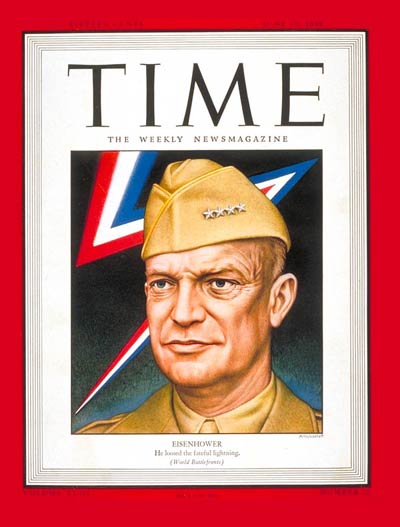
about a TIME Magazine Article
June 19, 1944


An article in the June 19, 1944 issue of TIME tells us that battalion aid stations were only 1000 yards from the front, among other things.

Medicine: That They Shall Not Die

Thousands of U.S. fighting men who would never have come home from World War I or any other past war will come home from the invasion. Thousands more, who in World War I would have been invalided for months or years, this time will be quickly and completely healed.

This mass saving of human life is made possible by the medical service that backs up the invasion. The man who organized that service is Major General Paul Ramsey Hawley, 53. Last week Major General Hawley's medical army moved D-day's wounded so swiftly that many a soldier hit on the Normandy beaches in the morning was recovering from his wounds the same night in a hospital in England.

For the Brave, the Best. Between Pearl Harbor and D-day Major General Hawley had integrated into one tremendous organization the best the U.S. had to send of surgical and medical genius, technique, supplies. He had also supervised the building of huge hospitals which, some Army doctors say, are better than those at home.

In preparing for the invasion's wounded, he and his Chief Surgical Consultant, Harvard's dynamic Dr. Elliott Cutler, insisted on one basic principle: chemotherapy is no substitute for prompt surgery. So they recruited numbers of good surgeons, organized them for front-line work, trained legions of Medical Corpsmen, litter bearers, ambulance drivers, aircraft crews, in expediting the wounded.

As in other battle areas, the invasion wounded are evacuated through a system of echelons, beginning with the single Medical Corpsman who follows each platoon (even if it travels by parachute), the litter bearers and the battalion aid station 1,000 yards from the front, and ending with convalescent hospitals in the U.S. In between come: 1) division clearing stations (usually about eight miles from the front), where the wounded are sorted according to their wounds; 2) mobile evacuation hospitals and field hospitals, 15 to 30 miles behind the lines; 3) station and convalescent hospitals in the rear. Ready for piecemeal hauling across the Channel are huge hospitals made of Nissen huts and bricks. When the beachheads deepen, many of the wounded will be put to bed in France.

Heroism Redundant. Major General Hawley believes that heroism is necessary on the battlefield, but not required of a wounded man. Last week he paced the docks at a South-of-England port, making sure for himself that the wounded were comfortable. He saw how tenderly the litter bearers (many of them Negroes) moved the stretchers from ships to docks, from docks to ambulances, watched the doctors change bandages and give morphine in the open air. He sighed with relief: "Didn't see a single man in pain. Not drugged, mind you—they were smoking cigarettes, many of them—but enough [morphine] so that they were comfortable." Said he when someone asked him how he got such a complicated organization working so smoothly: "Give a mouse a shot of hooch and he'll yell, 'Bring on the cats.' "

Fortunately, simple bullet wounds do not hurt much at first. For more severe wounds, Medical Corpsmen are ready on the battlefield with dope. If a wounded man can walk, he is bandaged and told where to go. If he cannot walk, litter bearers are sent for him. He gets some temporary patching at the battalion aid station and more at the clearing station.

There doctors expert in wound diagnosis decide which men, irrespective of rank, need priority in travel and treatment. In general, first priority goes to chest wounds (9% of casualties), abdominal wounds (4%). For desperate cases, General Hawley plans to use a system developed in Russia—many of the evacuation hospitals are specialty hospitals. Thus a touch-&-go casualty may be treated by a top-notch specialist from Johns Hopkins three hours after he is hit. Last week these urgent cases were often operated on in LSTs in mid-Channel—the evacuation hospitals had not yet crossed. Low priorities also go to men wounded in arms & legs—in Africa these comprised 60 to 65% of the wounded.*

In World War I, 61% of those not killed outright eventually returned to duty. In Africa, 64% were fit to fight again in 90 days. About 70% of Russia's wounded return to the front. Hawley's experts cautiously whisper that they hope to do as well during the invasion.

But if and when the invasion front stabilizes a little, General Hawley hopes to save nearly every wounded soldier who lives to reach his hospitals. In Italy only one-half of 1% of battle casualties who reached evacuation hospitals have died.

*A recent widespread rumor has it that many U.S. World War II casualties are "basket cases" (all four limbs amputated). In an editorial in last week's Military Surgeon the Medical Corps flatly contradicted this rumor. There have been no basket cases (to lose all four limbs would be fatal anyway), no cases with three lost limbs. The editorial called the rumor "a deliberate effort to undermine the morale of our people."

30 June, 2011

30 June, 1944

438th AAA AW BN
APO 403 % Postmaster, N.Y.
France
30 June, 1944     0930

My dearest girl –

It seems good to at least start writing on a clean sheet of paper. I managed to get hold of some, but how long it will stay clean and unwrinkled is problematical.

Last night I got two more letters from you and now I’m pretty nearly up to date to the 16th of June – which is darned good, I think. There are a few missing, but I’m able to imagine the blank spaces, dear. What makes me ‘mad’ is the fact that on the 16th of June – your latest letter from me was written May 21st. But the other fellows in our outfit say their folks are writing them the same thing, and your reference to the fact that some of the girls are again hearing in 10-12 days must mean that those fellows didn’t go anywhere. By now, anyway, you are hearing more regularly, I’m sure, darling. I’m sorry my letter with the enclosed check didn’t get to you in time but you’ll at least know I tried. At that time I was certain I was writing far enough in advance.

Your mention of the freak storm was interesting and I’m glad that on the whole – your home and surroundings were unaffected – also, that no one was hurt. I remember well the hurricane of a few years back. I was either an intern or resident then at Salem Hospital and we worked a good part of the night using battery lamps – on the casualties that kept drifting in. I was angry, too, because it had been my scheduled night off.

I do wish you’d get a little vacation, darling, just to get away for a change. You should have accepted Bea’s invitation for the 4th of July. It seems to me you ought to be able to cope with Arthur without too much difficulty. Anyway you know best.

I got a sort of news letter from the Salem Hospital. I’m enclosing it – thought you might like to see it; guess I’ll have to write and tell them I’m in France. The reference to a Dr. Poirier registering us in and out started when I asked him to put my light on once a week – for the price of 10 cents a year. He agreed and then started turning on everybody’s light who was in the service.

Well, Sweetheart, all this dribble and I haven’t yet reminded you of my love for you. I guess the reason for that is because like most humans – I like to save the best for last. I do love you, darling, more and more and miss you just as much. It is extremely gratifying to realize you feel the same way. That is really all we need dear – the rest will follow naturally. Do take care of yourself and don’t work too hard. I’ll have to close now, dear. My love to the folks and

All my love to you,
Greg


* TIDBIT *

about the Picture of the "Southout" to Come

Here is a map of the Enemy Order of Battle in West Normandy as of 30 June 1944, as marked by the Supreme Headquarters of the Allied Expeditionary Force (SHAEF).
CLICK ON MAP TO ENLARGE

©1993 - 2011 The Probert Encyclopaedia
Southampton, United Kingdom