13 July, 2011

13 July, 1944

438th AAA AW BN
APO 403 % Postmaster, N.Y.
France
13 July, 1944        1015

Dearest sweetheart –

Well I thought I’d try an Air mail again for a change and be sure and let me know – as soon as you can make any sense out of it – which type of mail is reaching you more quickly. In this direction – both types are now reaching us in about the same length of time. Our dental officer – jerk to you, dear – heard from Brooklyn (where else would he be from?) yesterday, in a letter dated July 3rd – which was excellent time. Yes, your description of the just mentioned as jerky – was very accurate. He is just that and at times quite intolerable. A Brooklyn Jew comes stamped – and he’s no exception. But we manage to keep peace and get along.

As for the rest of my detachment, darling – take it easy. That fat boy is the one who made the bracelet for you. I’m glad you like it – by the way – and had no idea they were so popular. I may or may not have told you that the thing was made by hand – including the links. The brothers you refer to are twins – formerly identical – and changing somewhat as they get older. They’re from Kentucky and real hillbillies. Before the war they helped manufacture moonshine. As for myself, dear, I’m just about the same, I guess. I haven’t been able to weigh myself in some time – but I have felt fine. Why I looked thinner in the picture – I don’t know.

Right now, though, darling – the thing that is keeping me fine is the chance to do some work – and work to do – there is! I went into the operating room at 1315 yesterday and didn’t move out of it until after 1800 – all in one stretch. I then ate and put in a couple of hours in the Shock ward before returning here. I got back here about 2130 and in a short while it was time for sleep. It certainly makes for a full day – because by the time I get thru shaving in the morning, filling out a few forms – etc. – it’s just about time enough to dash out, see a battery or a couple of gun sections – and then return for lunch. But – hell – I just hope the set-up continues and I think I can take it.

I wish I could go into detail on what I’ve been doing at the hospital – in just two days, mind you, dear the variety of cases is terrific – and in addition to just surgery – we put plaster-casts on by the dozen. And the best part of all is that as far as the hospital is concerned – I’m on one of their surgical teams.

I better stop raving because I suppose it will be for a short time only – but while it lasts – I can gain quite a bit of experience. Yes – just to scrub up, put on a cap, mask, gown and rubber gloves again has been quite a thrill for me – so excuse the enthusiasm sweetheart.

I’ll really have to stop now, dear and do a couple of things. I experimented with a flea powder issued by the gov’t. – by dissolving it in Kerosene and sprinkling it on our tents – as a mosquito repellent which as yet – has not been issued. It has worked fine now for 1 week – with only 1 sprinkling. I’m having some directions typed up and I’m getting it out to the batteries.

It seems as if I’m always rushed – when writing you, darling, – but you are not rushed in my mind – believe me, dear – because there you rest always as a comfort to me. Every bit of love you have for me is equaled on my account – of that you can be sure and time alone will give us a chance to show it. Meanwhile – don’t worry and take care of yourself. Love to the folks.

All my love for always –
Greg


* TIDBIT *

about The Drive South
and the Plan for Operation "Cobra"

On 2 July, VII Corps had taken over a sector between the VIII and XIX Corps in preparation for the drive south. Major General Robert C. Macon's 83d Infantry Division held the new Corps sector, a narrow front where operations were canalized by the Taute River and the swampy inundations of the Prairies Marecageuses. The 83d's attacks to gain maneuver room for the commitment of more troops met determined resistance, built about the hedgerows characteristic of this area. Dug into the earthen walls that marked each hedge, the German positions presented a defense that could be eliminated only by slow, tedious, and costly attacks.

The 4th Infantry Division joined the struggle, and later the Corps zone was extended eastward to include the area of the 9th. The infantry-artillery duel continued, gains were small, counterattacks were numerous and determined. The 4th and 83d Divisions continued to shoulder along the Carentan-Périers highway, more and more aided by the pressure exerted from the east by the 9th Division. On 13 July, that unit drove nearly to the important crossroads at les Champs-de-Losque.

According to Wikipedia:

In order to gain a decisive victory and to break through the area of hedgerow defenses, the First U.S. Army planned Operation Cobra, a coordinated attack by which the Army would drive south into areas more suited for the operation of its armored units. The originator of the idea for Operation Cobra remains disputed. According to Montgomery's official biographer, the foundation of Operation Cobra was laid on 13 June. General Omar Bradley later took credit for the planning of in his memoirs. However, Bradley's plan resembled—with only slight revisions—an earlier concept devised by none other than General George S. Patton. In any case, VII Corps was selected to make the main effort, and boundaries and troops began to be shifted to position the Corps for the task. It was to be launched on 25 July 1944.

In the first phase, the breakthrough attack would be conducted by the 9th and 30th Infantry divisions, which would punch a hole in the German tactical zone and then hold the flanks of the penetration while the 1st Infantry and 2nd Armored divisions pushed into the depth of the position until resistance collapsed. During the second phase, an exploitation force of five to six divisions would pass through the opening created in the German defenses and swing west. If these two phases were successful the western German position would become untenable, and the third phase would permit a relatively easy advance to the southwest end of the bocage to cut off and seize the Brittany peninsula. First Army's intelligence estimated that no German counterattack would occur in the first few days after Cobra's launch, and that if attacks materialized after that date, they would consist of no more than battalion-sized operations.

Cobra was to be a concentrated attack on a 7,000 yard (6,400 meter) front, unlike previous American "broad front" offensives, and would have heavy air support. Fighter-bombers would concentrate on hitting forward German defenses in a 250 yard (230 meter) belt immediately south of the Saint-Lô–Periers road, while heavy bombers would bomb to a depth of 2,500 yards (2,300 meters) behind the German main line of resistance. It was anticipated that the physical destruction and shock value of a short, intense preliminary bombardment would greatly weaken the German defense, so in addition to divisional artillery, Army- and Corps-level units would provide support, including nine heavy, five medium, and seven light artillery battalions. Over 1,000 tubes of divisional and corps artillery were committed to the offensive, and approximately 140,000 artillery rounds were allocated to the operation in VII Corps alone, with another 27,000 for VIII Corps.

12 July, 2011

12 July, 1944

V-MAIL

438th AAA AW BN
APO 403 % Postmaster, N.Y.
France
12 July, 1944
Dear Sweetheart –

I got two letters yesterday – the 24th and 27th and can well understand your reaction on learning we had left England. But I’m glad, dear, that you are taking the right attitude. Just have faith and all will be well. You remember I wrote you yesterday about trying to do some hospital work. Well I went to a nearby Evacuation Hospital. They handle cases after they have been seen in an aid station and a clearing station. They treat for shock, and operate on the shrapnel and bullet wounds etc., put plaster on fractures – etc. Well, sweetheart, that’s what I was doing yesterday from 1300 to 2100. It was the best day I’ve had in the Army in my 2 years – best because I was doing something to help and because I liked the work. I had spoken to the C.O. of the hospital in the a.m. and offered my help and offered to bring some aid men too. He was tickled and asked if I could do surgery. When I said yes – he assigned me to the O.R. and my men also. As it stands now – with the consent of my own C.O. – I’ll do my battalion work by noon – and shoot over to the hosp. for p.m. and evening work – as long as we remain anywhere near them. It’s really wonderful and I hope it lasts. Even if we move far from this one – we’ll volunteer for another. All for now, darling. I hope you share my enthusiasm. I love you, dear – remember?? Love to all and all my love to you –

Greg

* TIDBIT *

about Calvados

Yesterday, Greg mentioned becoming acquainted with "Calvados" in Douville. Here is some more about that.

In 1789, soon after the revolutionary government began wresting power from the king, the new National Assembly understood the need to divide the country into county-like administrative "departments", eventually leading to the creation of the department of Calvados. The major apple-growing area in Normandy is situated in and around the department of Calvados, whose beaches were the main staging area for D-Day, and whose lands became a central battle zone throughout the Invasion of Normandy. Cider had been distilled into brandy in Normandy, and specifically this area, since the 16th century. By the early 1800s the brandy produced in this area began taking on the name Calvados, that of the department at the heart of the production area.

Calvados begins with a good cider with the right mix of sweet, sour, and bitter-sweet apples, of which numerous varieties are grown in Normandy. Some ciders use up to two dozen varieties. After the apples are harvested in fall (sometimes into December), they are stored in a dry, well-aired place for anywhere from several days to several weeks before being pressed. The pulp is then slowly pressed, with the resulting liquid placed in air-tight vats, typically stainless steel, and allowed to ferment naturally over a period of six weeks to three months. The cider can then be filtered and pasteurized, depending on production methods.... or distilled to make Calvados brandy.

Calvados is made by single or double distilling the cider, then maturing the liquor in oak casks, hence the amber color. It’s said that making a good Calvados requires losing a lot of Calvados in the process. The first distillation of cider yields an intermediate product, the "petites eaux". The "heads" and "tails", which contain undesirable compounds, are carefully eliminated. These "petites eaux" are then heated for the second distillation, the "bonne chauffe". The heads and tails are once again eliminated. As it emerges from the still, Calvados is colorless, produces a burning sensation on the palate, and gives off an aroma of fruit and alcohol. After two years aging in oak casks, it can be sold as Calvados and is more or less 42 percent alcohol. The longer it is aged, the smoother the drink becomes. Usually the maturation goes on for several years. A bottle of twenty-year-old Calvados can easily command double the price of a bottle of ten-year-old Calvados.

Calvados — affectionately known as calva — is appreciated as an after-dinner drink or digestif and is increasingly promoted for use in cocktails. Prior to WWII it was probably best known as a way of convivially ending a meal in the form of café-calva, still practiced, whereby a shot of brandy is served at the same time as a shot of espresso. The café and the calva are then either downed — first the café then the calva — each in its own receptacles or by drinking the café then pouring the calva into the warm coffee cup. The imbibing of a café-calva is to be performed with a sense of pastoral well-being or old-chum camaraderie. This sounds much like Greg's experience in a farmhouse on 1 July, causing him to "zigzag".

One long-time tradition in the drinking of Calvados is le trou Normand, or "the Norman hole". This is a small drink of Calvados taken between courses in a very long meal, sometimes with apple sorbet, to aid in digestion and to re-awaken the appetite. Calvados can be served as apéritif, blended in drinks, between meals, as a digestif, or with coffee. Well-made calvados should naturally be reminiscent of apples and pears, balanced with flavors of aging. The longer it is aged, the smoother the drink becomes. Usually the maturation goes on for several years. A bottle of twenty-year-old Calvados can easily command double the price of a bottle of ten-year-old Calvados. The less-aged calvados distinguishes itself with its fresh apple and pear aromas. The more-aged calvados tastes more like any other aged brandy. As Calvados ages, it may become golden or darker brown with orange elements and red mahogany. The nose and palate are delicate with a concentration of aged apples and dried apricots balanced with butterscotch, nut and chocolate aromas.

Here are a picture of an orchard with apples grown to make Calvados as well as a picture of aging barrels:

CLICK ON PICTURES TO ENLARGE


And now for something a little different. A travel site has posted that on a farm along the Normandy cider route a guest can sleep in a Calvados barrel. Yes, that’s the barrel used to store that delicious Norman apple brandy! The barrels have been converted into small rooms, for no more than two people, and are firmly anchored into the soil, leaving no fear of rolling away during a windy night!


Cider Barrel: Sleeps Two!

11 July, 2011

11 July, 1944

V-MAIL

438th AAA AW BN
APO 403 % Postmaster, N.Y.
France
11 July, 1944

Hello darling!

Tuesday morning and a little sunshine. On 2 successive Mondays it has rained and the days were sort of blue. But things look pretty good today, dear.

Yesterday I was visited by a friend of mine – a Colonel in AA whom I knew with Col. Pereira on maneuvers last year. He heard we were around and he dropped in. We had a nice long talk and reminisced about our days down South in 1943.

This morning I’m going to go to a nearby Army hospital and ask the C.O. if he can use any help. I’ve talked with my Col. and he said it was all right with him. If I can do even part time work of any sort – it will be welcome. I’ll let you know later, dear, how I make out.

Other than that – nothing new and all is comparatively quiet here. My health is excellent darling – so don’t worry. Remember I love you and think only of that. Love to the folks.

All my love, dear
Greg

Route of the Question Mark


[CLICK TO ENLARGE]

(A) St. Come-du-Mont (2 July, 1944) to
(B)
Douville (11 July, 1944)
("Douville" was renamed "Donville")

The end of Page 23 from The Route of the Question Mark tells this:

page 23

July 11... Douville. The truck drivers cleaned the cables on their vehicles, and it was a common sight to see apple trees pulled over when this operation was in progress. We first became acquainted with Calvados here, we pitched horse-shoes, we painted stars and moons and other inscriptions on our movie tent, and CHEETY shot a cow for the kitchen.


Orchard in Donville (today)
as seen through a Hedgerow

10 July, 2011

10 July, 1944

V-MAIL

438th AAA AW BN
APO 403 % Postmaster, N.Y.
France
10 July, 1944

Dearest Girl –

Got a letter from you yesterday telling about Les’s wedding, one from Florence B, and 3 from my brother – the last – a V-mail – dated 30 June – which is damned good. I think you’re probably correct about receiving V-mail quicker, dear. Lawrence seemed quite affected at the news that I was in this thing. I just hope that all of you are not worrying too much.

The wedding sounded swell – although I agree – too large. Give them my best wishes, darling, and I sure do envy them. Florence’s letter was very nice and it’s swell of her to continue to write. I also got a letter from my Dad thanking us for his gift. He told me of your staying at Winthrop, darling, and he says it thrills him to have you stay with them because you are now no different than any of his children. Gosh, dear, it certainly is swell to read that everything is so amiable and pleasant between you and my folks and I know that it will be the same between your folks and me – as soon as I can get back. You know – I think you and I really ought to hit it off well when we get married. What a way to talk! Well – as you say – I haven’t even seen my fiancée’s ring. But what of that – I’ve seen my fiancée and I know her – and I know she’s the girl for me! By the way – I love her, too. Love to the folks, sweetheart and

All my love for always
Greg


* TIDBIT *

about Battle Casualties Sustained by VII Corps
6 June - 1 July, 1944

Unit                     Killed     Wounded   Missing    Captured         Total
4th Inf Division       844       3,814          788            6             5,452
9th Inf Division       301       2,061            76            0             5,438
79th Inf Division     240       1,896           240           0             2,438
90th Inf Division     386       1,979             34           0             2,376
82d A/B Div            457       1,440        2,571         12             4,480
101st A/B Div         546       2,217        1,907           0             4,480
Corps Troops            37          157            49          61                304
All Units               2,811     13,564        5,665         79            22,119

09 July, 2011

09 July, 1944

V-MAIL

438th AAA AW BN
APO 403 % Postmaster, N.Y.
France
9 July, 1944

Dear Sweetheart –

I’m writing you a bit later in the day because I’ve been busy up to this moment. This morning I got a call to go to a nearby farmer’s house and found a woman in premature labor. She was between 6 and 7 mos pregnant and had been terrifically frightened by a recent shelling. Well – with what instruments I had, plus some towels – I delivered her. The baby was stillborn, of course – but she was certainly glad to get it over with. It’s been some time now since I delivered anyone – but it was just as natural as anything – except for the poor working conditions. One of my boys acted as a midwife – there being no neighbors around to help.

Perhaps the farmers house was outside of this town...

CLICK ON IMAGES TO ENLARGE


Everything is going along fine here, darling. Didn’t get any mail yesterday – but should today. Hope all is going well at home, dear. There’s nothing to worry about from this point. That’s all for now except to remind you yet again that I Love You very much. Love to the folks.

All my love for now
Greg

* TIDBIT *

about The Allied Taking of Caen

The Second World War 60th Anniversary (No. 4) booklet entitled "The Drive on Caen, Northern France, 7 June - 9 July 1944" (Crown copyright 2004), written by Lloyd Clark and Dr. Stephen Hart for the Department of War Studies at the Royal Military Academy Sandhurst, contains an excellent summary of the Allied taking of Caen. Here are excerpts:

Caen is the ancient capital of Lower Normandy, situated 148 miles NW of Paris and 74 miles SE of Cherbourg on the banks of the River Orne. It was a vital road and rail junction that the Allies needed to capture before they could advance south through the excellent tank country of the Falaise Plain. Because of its strategic significance, Hitler had ordered that Caen be defended to the last man by the well-prepared and resolute German defense that included fanatical SS soldiers and the potent 'Hitler Youth' Armored Division. The Royal Air Force played a crucial part in the Drive on Caen with more than 1250 aircraft, operating from bases in Normandy and Britain, destroying numerous tanks and armored vehicles as well as attacking railway traffic bringing reinforcements into the area. The British Second Army sought to capture Caen while the American First Army aimed to seize the port of Cherbourg. General Montgomery had hoped Caen might be reached on D-Day itself, but northern Caen did not fall until 9 July.

In the days immediately following D-Day, in Operation "Perch" (9-14 June), the Second (British) Army found themselves in a series of fierce actions against determined enemy resistance. In the first three days, they managed to push the front line only a few miles further south while incurring heavy casualties. On 12 June Lieutenant-General Bucknall learned there was a weak spot in the German line five miles SSW of Bayeaux. He ordered his 7th Armored Division (known as the "Desert Rats") to swing west around the resilient German defensive line, and audaciously thrust west to seize the high ground at Villers-Bocage, thus threatening the rear of the elite 12th SS Hitler Youth Armored Division. They were able to capture Villers-Bocage by the 13th of June. Unfortunately, the commander of an SS Heavy Tank Battalion - and one of Germany's leading tank aces - responded by launching a series of rapid counter-attacks using 13 Tiger heavy tanks supported by infantry. The British forces in Villers-Bocage were caught by surprise and within two hours were mauled, losing 53 armored vehicles in the process. Wittmann lost four of his precious Tigers.

In the aftermath of the setback at Villers-Bocage, the Second (British) Army mounted small-scale attacks, compelling the Germans to commit their newly arriving armored reserves to shore up their hard-pressed front line. Montgomery felt that this fulfilled his original intention of aiding the American advance towards Cherbourg by tying down German resources in the east. Meanwhile, Operation "Epsom" was developed for the next major offensive against Caen (25-30 June). The aim was to cross the River Odin in the close hedgerow countryside to the west of Caen, push beyond the Orne and seize the high ground that commanded the southern approaches to the city. If successful, this advance would compel the Germans to withdraw from Caen. Over 700 guns, 600 tanks and 60,000 troops (with little combat experience) were available for this campaign. Waiting in well-prepared defensive positions was the potent German 12th SS Hitler Youth. The 2nd SS Armored division and II-SS Armored Corps were moving toward the area to launch a major counter-offensive against Bayeaux that would throw the enemy back into the sea.

The great storm of 19-22 June upset preparations for Epsom, and denied the British the planned preliminary aerial bombing raid on the German positions. On 25 June a preparatory attack failed even though the RAF flew 525 sorties to prevent Luftwaffe operations over the battlefield. Close air support was also disabled by the weather, and, in spite of massive artillery support, enemy fire poured into the British from three sides on 26 June. Still, British tanks attempted to push down to the River Odon. Several thrusts were stopped. During the night of 26-27 June, help from reinforcements allowed the British to cross the Oden and establish a bridgehead to its south. On the 27th, the Germans received orders to attack the British on the Odon and after much give and take, pushed the British back across the Odon by the 29th. However, weather now permitted British aircraft both to intervene in Germany's attempt to bring in reinforcements and to keep the Luftwaffe out of the ground battle. Tenacious British defense and accurate artillery fire fragmented German attacks. But caution kept the British on the defensive, and Epsom was concluded prematurely on 30 June, having cost the British some 4020 casualties, 58% of which were within the 15th (Scottish) Division.

During 1–2 July, the II-SS Armored Corps continued to probe and bombard the Odon Valley and the British tried to improve their own positions, but neither side launched major attacks. It was not until 8 July that the next offensive against Caen, code-named Operation "Charnwood", was launched. To soften up the German defenses prior to the attack, as well as to limit the enemy's ability to resupply their forces, Montgomery requested a massive aerial strike. During the late evening of 7 July, 443 British Lancaster and Halifax heavy bombers dropped 2,276 tons of munitions on Caen. Because of concerns about the risk of friendly-fire casualties, Montgomery's staff asked Bomber Command to strike the rear portion of the German defensive zone, located along the northern fringe of the city, four miles behind the front line. Unfortunately, the bombing instead inflicted heavy losses on French civilians and only modest casualties to the enemy. It also left the battle area severely cratered, thus hampering Allied ground operations. Finally, the Allieds left a 5-hour gap between the bombing and the ground assault which gave the enemy time to recover. The major benefit was that stray bombs destroyed several of the city's bridges thus hampering the enemy's resupply efforts.

CLICK ON PICTURES TO ENLARGE

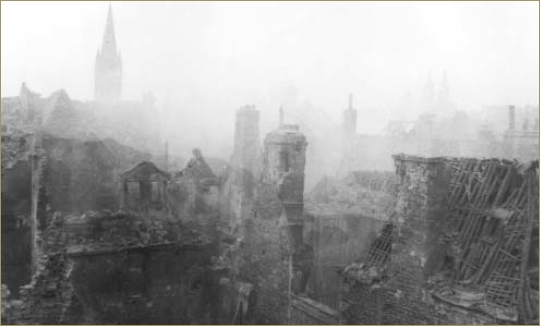
Northern Caen Smolders after Attacks by Allied Bombers

Just before midnight on 7 June, massed Allied artillery initiated a powerful bombardment that continued until the ground attack began four hours later on 8 July. With the Germans temporarily stunned, the initial attacks went well. By dawn, the initial phase of the operation was complete. The Allies had advanced 1-1/4miles deep into the German position. Next, British fighter bombers struck dozens of enemy positions, followed by 250 American medium bombers softening up the enemy in preparation for the second phase of the offensive. By nightfall, three concentric divisional thrusts had reached a line less than 950 yards north of the city. During the night, the Germans began to withdraw their heavy weapons and some of their now exhausted troops from the northern half of the city, defying Hitler's express order that Caen be held to the last man. On the morning of 9 July Allied forces fought their way painfully through the rubble morass that had once been Caen, their progress slowed by German snipers, booby traps and mines. In two days of savage fighting, First (British) Corps had incurred 3500 casualties but had captured northern Caen. Not much remained of Caen on 10 July 1944.


Rue de Bayeux, Caen after Bombs of 8 July 1944


Rue de Bayeux, Today

08 July, 2011

08 July, 1944

438th AAA AW BN
APO 403 % Postmaster, N.Y.
France
8 July, 1944          0950

Dearest darling Wilma –

This is Saturday morning and as always, I have to submit my weekly report. That having been done I’m now ready to write you. Yesterday was the banner day for us since arriving in France. I got two letters from you – June 21 and 22 – and one each from my father and yours. The latter thanked me for remembering him on Father’s day – and his letter in general was very well expressed. I was glad to hear from him. My father’s letter was written on June 21st and he hadn’t received his gift yet. He told me about being in Winthrop and that my mother missed my not coming home week-ends. Well – I do, too, darling – although as I remember it, once I met you last summer, I spent precious little time at home anyway. Boy – last summer seems like a dream from where I’m sitting now – but I know it was and is reality. Both you and my dad express satisfaction at my being in England as late as June 8th – as my father wrote. I hope you didn’t worry too much, dear, shortly after that. By now of course – you’ve heard from me in France. I’ve tried to give you as accurate a picture as possible – but I can’t go into tactics, sweetheart, for obvious reasons. And the fact is – that outside of a discussion of tactical changes from day to day – there’s really nothing to report. There’s such a world of difference between training or living in garrison as we did in England – and the real thing.

I liked your letter written on Red Cross stationery – particularly the telegram work sheet part which I believe I would have filled out in just about the same manner. I’m indeed glad you’re not bored – and I believe you when you write it; I also believe that you really like my folks and that, darling, is a very comforting thought – because I’ve seen so much of the opposite. This I know – they’ll never interfere in anything you or I want to do. I don’t mean active interference – but passive interference – which is the aggravating kind. What they want most is for us to be happy and we won’t let them down I know.

Yesterday p.m. I visited some of the gun sections of one of the batteries. In so doing I had to pass through a small town. I got the urge to eat some potatoes and meat – so I had my driver scout around the town. In reality – the town was off limits to the troops – but with a large Red Cross painted on the hood – and waving a R.C. flag – the M.P.’s don’t bother us much. Well after a little questioning here and there I found a source of potatoes and was able to buy 40 kilograms for 100 francs. A kilo – in case you don’t remember dear – is 2.2 lbs. Everything here is in kilograms for wt. and kilometers for distance. I then found a butcher’s which hadn’t been entirely destroyed by shelling and bought something that looked like steak (it tasted like leather) and bought 14 pieces – one for each officer in Headquarters – and I paid 100 francs for that also. (1 fr = 2 cents). To finish it off – I got some onions – brought it all back and we had steak, french fried potatoes and fr. Onions. What a treat! It was the first potatoes and fresh, uncanned meat we had had since arrival. The pay off is this: some of the liquor we had been given – remember I told you about it – still remained – and it consisted of 5 bottles of champagne! Well we killed that too. Now how’s that for living in the field?

CLICK ON PICTURES TO ENLARGE

Near Carentan, Normandy
June 1944
My driver - Sgt. Shoup and Sgt. Kirby
Apparatus on side - besides entrenching tools
is a splint-set for the leg.

What else? Well I must remind you again darling that I love you most sincerely, constantly and deeply – and – to put it awkwardly, the farther away I get from you, the more I love you! Boy! That’s grounds for a break in relationship – but I’m a sucker for a “bon mot” – as the French would put it. At any rate, sweetheart – no matter how far away I get – my love for you grows stronger and I’ve been away long enough now – to know what I’m writing.

Postcards of Carentan from Greg

CLICK ON IMAGES TO ENLARGE

Hôtel de ville


Hôtel de ville de Carentan today


Notre Dame Church


Mass is Celebrated in Notre Dame Church in Carentan
for 101st Airborne and other Allied Soldiers
Photo Owned by PhotosNormandie's Photostream


Notre Dame Church Today


Rue de L'Isle


Rue de L'Isle Today

I’ll have to close now, dearest. Don’t work too hard, don’t worry too much, don’t stop loving me – and – don’t you think that’s enough for now?

Love to the folks and
All my love is yours, dear
Greg

07 July, 2011

07 July, 1944

V-MAIL

438th AAA AW BN
APO 403 % Postmaster, N.Y.
France
7 July, 1944

Hello darling!

Well last night, believe it or not, I saw a movie – right out in a field – but under an apple tree. The screen was rigged up in such a way as not to show any light. Unfortunately the picture was terrible – Gloria Jean in “Moonlight in Vermont” – if you can imagine such a thing. But you’ve got to give our Special Service Officer credit for arranging it. The relaxation was wonderful for 1½ hours.

This might have been the field and apple
tree where the movie was shown.

CLICK ON IMAGES TO ENLARGE

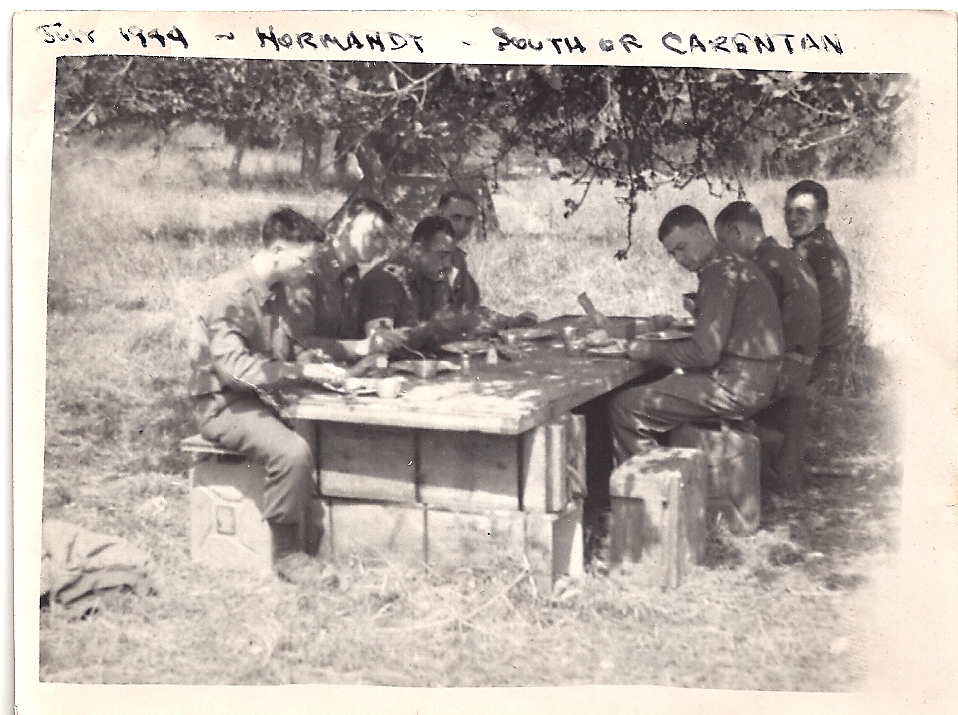
July 1944 - Normandy - South of Carentan

No mail yesterday, Sweetheart – but there should be some today, I hope. Everything has been going along well and I’m not complaining. There seems to be a certain optimism around these parts that the Jerries can’t possibly fight very long. The power we have is terrific and even the fanatical Hitler-Jugend that are being captured – say they never faced anything so terrible.

All for now, dear. Love to the folks and

All my love
Greg

* TIDBIT *

about Hitler-Jugend

CLICK ON PICTURES TO ENLARGE

Hitler Youth Recruitment Poster
"Youth Serves the Leader"
"All 10 Year Olds into the Hitler Youth"

The Hitler-Jugend (HJ) (Hitler Youth) was a paramilitary organization of the Nazi Party which existed from 1922 to 1945. It was made up of the Hitlerjugend proper, for male youths ages 14–18; the younger boys' section Deutsches Jungvolk for ages 10–14; and the Bund Deutscher Mädel for girls. The HJ were viewed as future "Aryan Supermen" and were indoctrinated in anti-Semitism. One aim was to instill the motivation that would enable HJ members, as soldiers, to fight faithfully for the Third Reich. The HJ put more emphasis on physical and military training than on academic study. Many HJ activities closely resembled military training, with weapons training, assault course circuits and basic tactics. Some cruelty by the older boys toward the younger ones was tolerated and even encouraged, since it was believed this would weed out the unfit and harden the rest. By December 1936, HJ membership stood at just over five million. That same month, HJ membership became mandatory for Aryans, under the Gesetz über die Hitlerjugend law. This legal obligation was re-affirmed in 1939 when membership was required even if it was opposed by a child's parents. By 1940, it had eight million members.

In 1943, Nazi leaders began turning the Hitler Youth into a military reserve to increase manpower which had been depleted due to tremendous military losses. In February 1943, the 12th SS Panzer (armored) Division Hitlerjugend, under the command of SS (Protective Squadron) Brigadeführer (Major General)  Fritz Witt, was formed. The Division was a fully equipped Waffen-(Armed)-SS Panzer division, with the majority of the enlisted force being drawn from Hitler Youth boys between the ages of 16 and 18. By 1 September 1943, over 16,000 recruits had completed their six-week basic training. Many of the recruits were so young that they were supplied with sweets instead of the standard tobacco and alcohol ration.

The Hitlerjugend Division was unique because the majority of its junior enlisted men were drawn from members of the long-indoctrinated Hitler Youth, while the senior NCOs and officers were generally experienced veterans of the Eastern Front. The division, with 20,540 personnel, first saw action on 7 June 1944 when deployed against the British and Canadian forces to the north of Caen. During the following months, the division earned itself a reputation for ferocity and fanaticism.